בס”ד
.
.
.
According to the Gemara the Rabbanan maintain that a sukkah is a דירת עראי. There are many contextual indications to this fact within Masechet Sukkah. However, one of the most pointed statements regarding this is in Yoma 10b where it directly states: ורבנן לטעמייהו, דאמרי: סוכה דירת עראי בעינן. This being the case, how did the Rabbanan maintain their opinion that a sukkah is a דירת עראי in opposition to Rebbi Yehuda, when Rebbi Yehuda brings a מעשה on Sukkah 2b regarding Queen Helene’s sukkah that was over 20 amos high and the Elders were silent, as the Baraisa states: סוכה שהיא גבוהה למעלה מעשרים אמה — פסולה ורבי יהודה מכשיר עד ארבעים וחמשים אמה. אמר רבי יהודה: מעשה בהילני המלכה בלוד שהיתה סוכתה גבוהה מעשרים אמה, והיו זקנים נכנסין ויוצאין לשם ולא אמרו לה דבר.
Therefore, if the Rabbanan who hold that a sukkah is a דירת עראי are assumed to be the opinion of Tanna Kamma of Masechet Sukkah, Mishna 2a, which states that a sukkah above 20 amos is invalid, what logical defense did they employ to avoid refutation by Rebbi Yehuda’s Baraisa regarding Queen Helene’s sukkah that was over 20 amos high and the Elders were silent?
This d’var Torah attempts to provide an answer to the above question by:
- Illustrating Rebbi Yehuda’s opinion of קבע in Mishna 2a and on daf 7b, as meaning that a sukkah can be higher than 20 amos in height or greater than 4×4 amos in length and width in accordance with the Meiri.
- Explaining how the three dictums in the name of Rav on 2b regarding the dispute between the Tanna Kamma and Rebbi Yehuda in a sukkah above 20 amos are not contradictions but represent multiple opinions of Tannaim which were accurately transmitted by Rav to R’ Yoshiyah, Rav Huna, and Rav Chanan bar Rabbah.
- Explaining the source and reason behind Rav Chanan bar Rabbah’s dictum in the name of Rav on 2b that states that the dispute with Rebbi Yehuda in a sukkah above 20 amos is at ראשו ורובו ושולחנו.
- Explaining how the seemingly abrupt transition from the Baraisa of Queen Helene’s sukkah to Rav Shmuel bar Yitzchak stating the halacha for a minimum size sukkah are not separate topics but related.
- Redefining the concept of a דירת עראי.
- Extrapolating a more complete understanding from the language of the Gemara.
.
.
Chapter 1 – Questions and Answers on Masechet Sukkah
.
What is the overall structural approach of the Gemara in seeking to understand the individual statements of Masechet Sukkah, Mishna 2a?
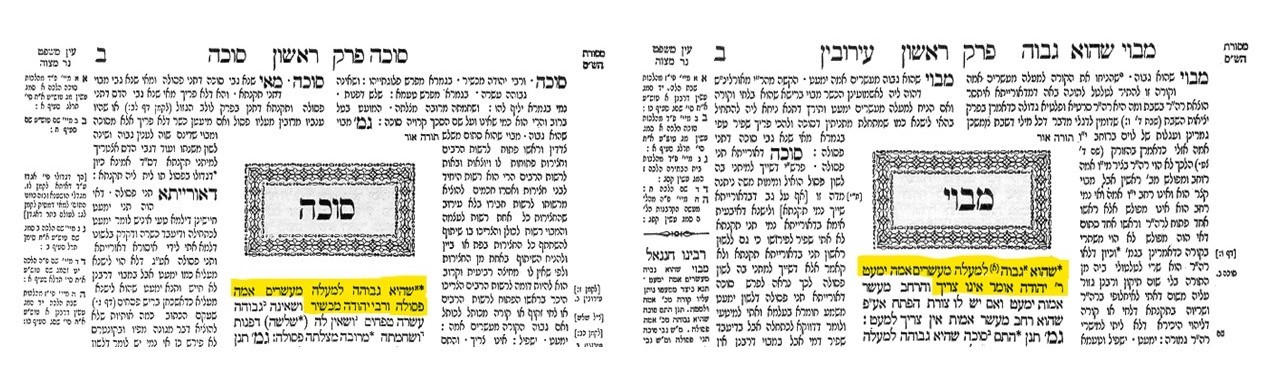
The Gemara begins examining Mishna 2a by comparing the רישא of our Mishna to the רישא of the Mishna in Eruvin 2a. As such, a continuous thread of logical thought unfolds from Sukkah 2a through 6b to methodically proceed through all the factors that affect the limitations and calculations of the height of s’chach from the floor of a sukkah.
(End.)
.
.
What is being taught by the Gemara when it begins by asking what is unique about a sukkah whose s’chach is higher than 20 amos compared to a mavoi whose korah is higher than 20 amos?
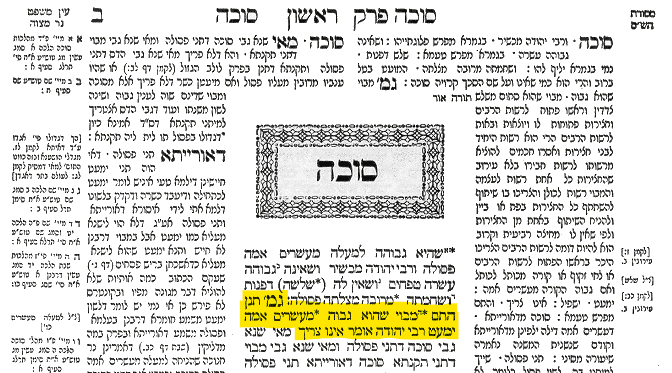
In quoting only the רישא of the Mishna in Eruvin 2a, the Gemara asks two different questions on Sukkah 2a: מאי שנא גבי סוכה דתני פסולה. ומאי שנא גבי מבוי דתני תקנתא. Why is one question insufficient that the Gemara needed to ask both of these questions?
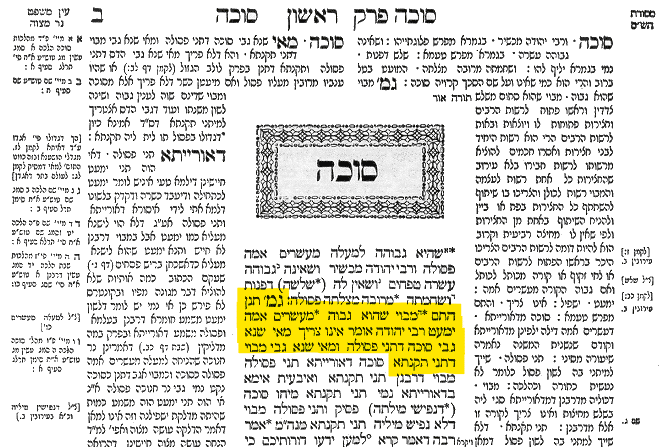
In response to the first question the Gemara states that the uniqueness of a סוכה whose s’chach is higher than 20 amos is that it violates a Torah law and makes the entire sukkah structure invalid. Rashi explains regarding a מבוי whose korah is higher than 20 amos, that it would be improper to use the language of פסולה because while it violates a Rabbinic requirement it does not invalidate the entire mavoi structure. Therefore, a סוכה is unique because a person can state פסולה because it is a דאורייתא.
After accepting the uniqueness of a sukkah which allows us to state פסולה, the Gemara then proceeds to address the second question regarding the uniqueness of a מבוי that allows us to exclusively state a תקנתא. The Gemara does this by way of first suggesting that perhaps a מבוי is not unique because a person could state a תקנתא for a דאורייתא and say in regard to a sukkah ימעט if the sukkah’s s’chach is higher than 20 amos, as the Gemara states: ואיבעית אימא בדאורייתא נמי תני תקנתא.
However, the Gemara explains that even though in general a תקנתא could be given for a דאורייתא, in the specific case of a sukkah whose s’chach is higher than 20 amos, there are numerous details regarding the lowering of the s’chach of a sukkah that prevents a person from simply stating ימעט as a remedy, מיהו סוכה דנפישי מילתה. Therefore, the answer to the second question is that a mavoi is unique from a sukkah in that it can exclusively state a תקנתא regarding its korah which is over 20 amos, because the details involved are not numerous, מבוי דלא נפיש מיליה. Consequently, the korah simply needs to be lowered, ימעט. This cannot be stated by a sukkah because the details for lowering s’chach are numerous.
In order to explain how and why the details for lowering s’chach are numerous, the Gemara proceeds with providing the necessary context by first listing the three opinions of the Amoraim regarding the possible sources for 20 amos height limitation of a sukkah. Then it highlights multiple corresponding dicta in the name of Rav on 2b, each of which would consequently impact the requirements for lowering s’chach in different ways. For instance, R’ Yoshiyah said in the name of Rav, that the dispute between the Tanna Kamma and Rebbi Yehuda is where the walls do not reach the s’chach. Therefore, according to this opinion a sukkah above twenty amos whose walls reach the s’chach is not פסול and it need not be lowered at all. Whereas a sukkah whose walls do not reach the s’chach must be lowered to 20 amos or below. However, according to Rav Huna in the name of Rav, the dispute is at exactly 4×4 amos, which establishes a required shade ratio of 1:5 (length to height). Therefore, if the sukkah is 5×5 amos and the s’chach is at 26 amos in height, it needs to be lowered only 1 amah and not necessarily to 20 amos. In addition, according to this opinion a sukkah of 3×3 amos that is over 20 amos in height, even if it were lowered to 16 amos it would still be פסול. Next, according to Rav Chanan bar Rabbah the dispute is at ראשו ורובו ושולחנו. And as it shall be explained further below, if the sukkah is exactly ראשו ורובו ושולחנו then the sukkah must be lowered to 20 amos or below. However, if the sukkah were larger than ראשו ורובו ושולחנו, depending on its length and width it may or may not need to be lowered.
In addition to understanding the structure and logical flow of the Gemara in this straightforward manner, a proof for this approach to the Gemara can be found in the words of Chazal who stated on 2a, מיהו סוכה דנפישינ מיליה. Do not read דנפישי מילתה. Chazal precisely indicated the intent of their words by using the masculine form to ensure that the reader understood that the entire conversation was specifically regarding the numerous laws for lowering the s’chach (סכך) of a sukkah and not about the entire sukkah (סוכה) structure in general. Therefore, the Gemara is only analyzing the רישא of Mishna 2a for the singular purpose of understanding the limitations and calculations of the height of s’chach from the floor of a sukkah.

(End.)
.
.
What is the definition of a דירת עראי?
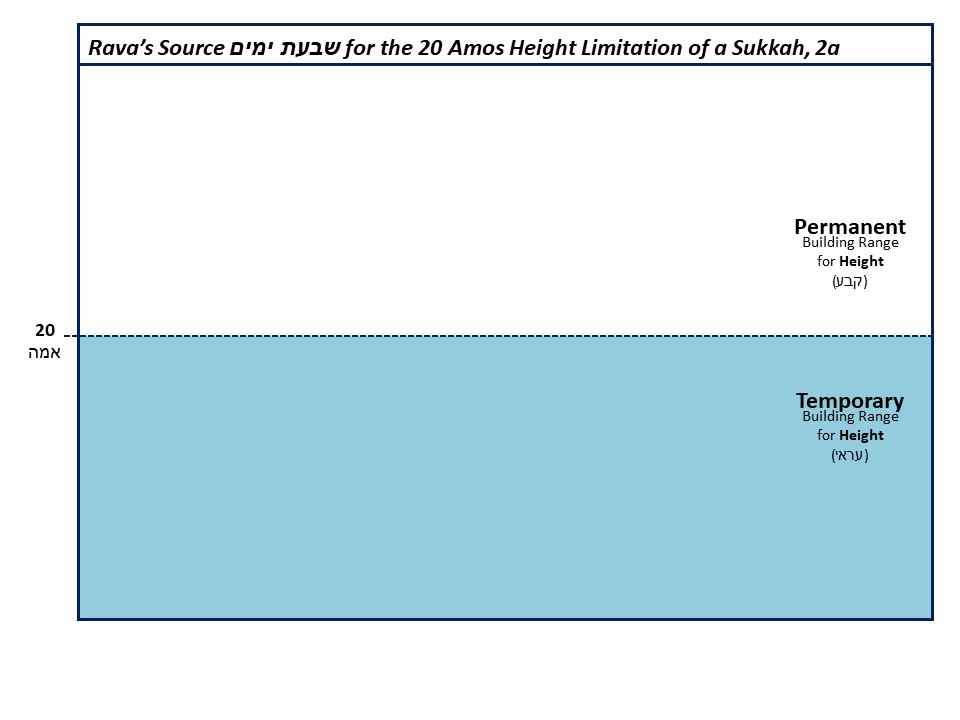
Rava states that temporariness is not determined by the materials used to construct a sukkah. Rather, temporariness is determined by an abstract dimensional range. Any sukkah constructed up to 20 amos in height is a דירת עראי.
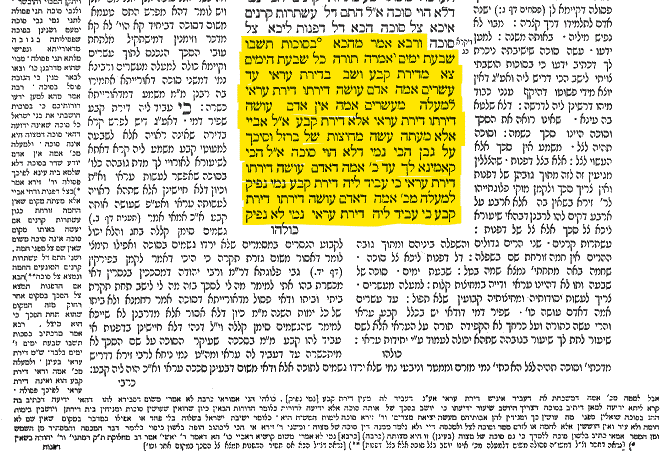
And, even if a person builds his sukkah out of temporary materials or in a temporary fashion above 20 amos he does not fulfill his obligation because his sukkah would occupy a dimension of קבע, as Rava restates and clarifies this point to Abaye on 2a: הכי קאמינא לך עד כ’ אמה דאדם עושה דירתו דירת עראי כי עביד ליה דירת קבע נמי נפיק למעלה מכ’ אמה דאדם עושה דירתו דירת קבע כי עביד ליה דירת עראי נמי לא נפיק.
The literal meaning of Rava’s words are that a person could build a materially weak or poorly fastened “seven-day” sukkah above 20 amos that would prove to only last temporarily (see the Bach §633). As such, Rava informs us that a sukkah’s material makeup or lack of sturdiness in construction does not matter at all. If a דירת עראי occupies the abstract dimension of קבע above 20 amos, it would actually be a דירת קבע and not as Abaye would have thought, a דירת עראי. Therefore, a materially weak or loosely constructed sukkah above 20 amos is invalid. Just as conversely a sukkah made with מחיצות של ברזל is actually a דירת עראי and not a דירת קבע when it occupies the dimensional space of 20 amos or less.

And even though Rashi deviates from the simple meaning of Rava’s words and understands differently than the Bach in stating that it is impossible to build a דירת עראי above 20 amos due to a connection to its material construct, he still concludes in his commentary on Gemara 2b that Rabbah and Rebbi Zeira did not agree with Rava’s source for the 20 amos height limitation of a sukkah because they did not want to learn out from the words שבעת ימים an abstract measurement regarding the concept of temporariness and permanent. Instead, they felt that if the words שבעת ימים could be interpreted to mean that a sukkah should be built in some sort of temporary fashion, it would have to be understood as Abaye did in the terms of the material construct of the sukkah.
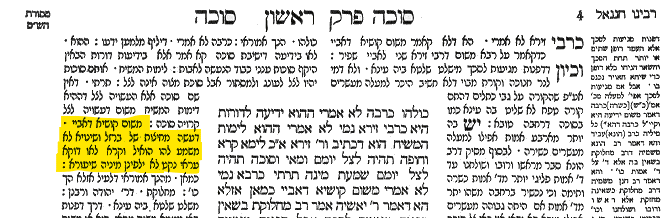
Another proof that the definition of a דירת עראי is not determined by the materials used but is an abstract range determined as 20 amos or less can be learned from Gemara 7b where Rebbi Yehuda is listed as one of eight Tannaim that hold that a sukkah is a דירת קבע on the basis that he validates a sukkah above 20 amos in height. From this we find a proof for Rava’s understanding that a sukkah which is built at 20 amos or lower in height is in the dimensional range of what is considered a דירת עראי.

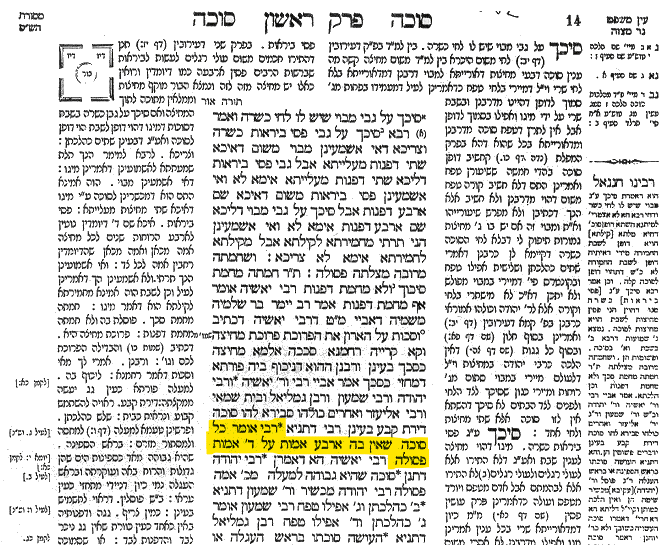
Additionally, this understanding of an abstract measurement verses a material concept of עראי and קבע is further observed in the same Gemara on 7b in referencing Rebbe’s opinion that the קבע of a sukkah is established as one that is 4×4 amos or greater, regardless of its material construction. And conversely, Rebbe maintains that a sukkah that is built at less than 4×4 amos is a דירת עראי.
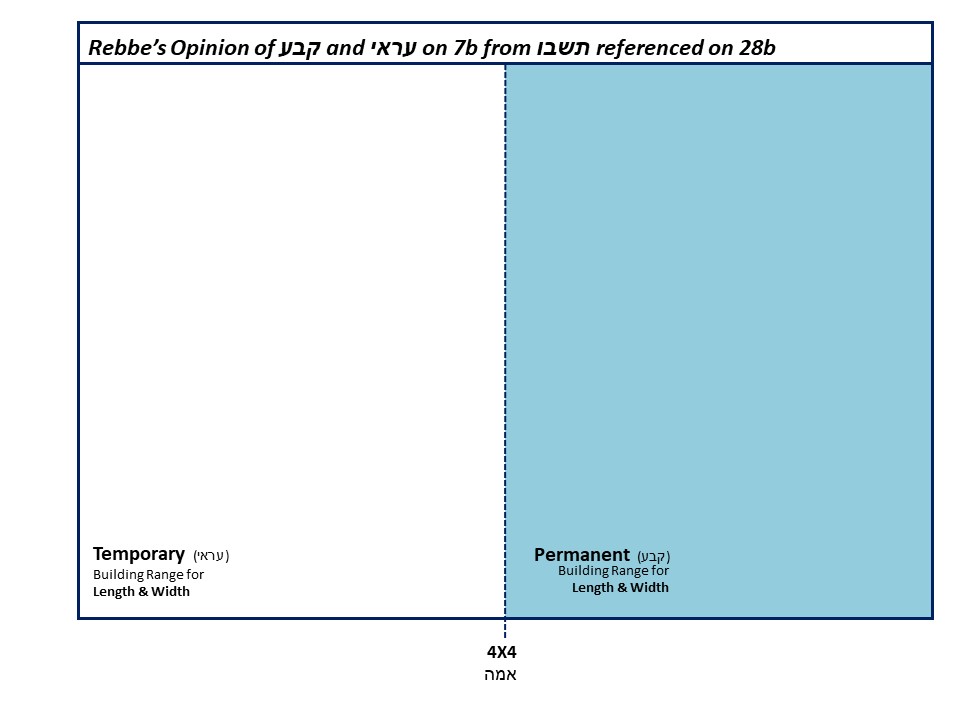
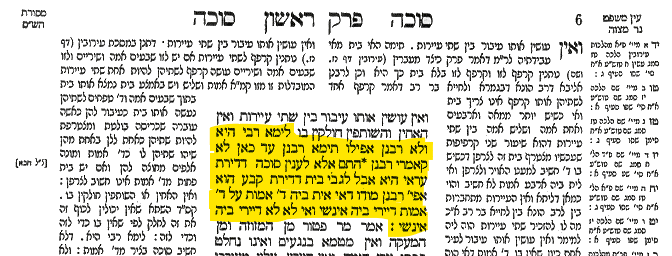
Furthermore, on the basis of an abstract measurement of 4×4 amos, the Baraisa on 3b regarding the laws of houses determines whether a house is a דירת קבע or a דירת עראי.
(End.)
.
.
Does Rebbi Yehuda allow a sukkah to be built at 20 amos or less in height?
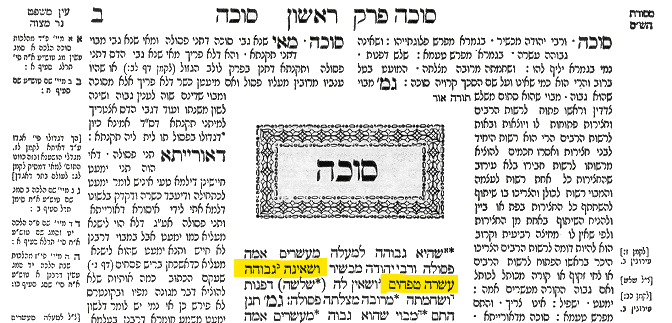
Yes, as he agrees with Mishna 2a that states: ושאינה גבוהה עשרה טפחים. Therefore, a sukkah that is built 10 tefachim or higher is valid.
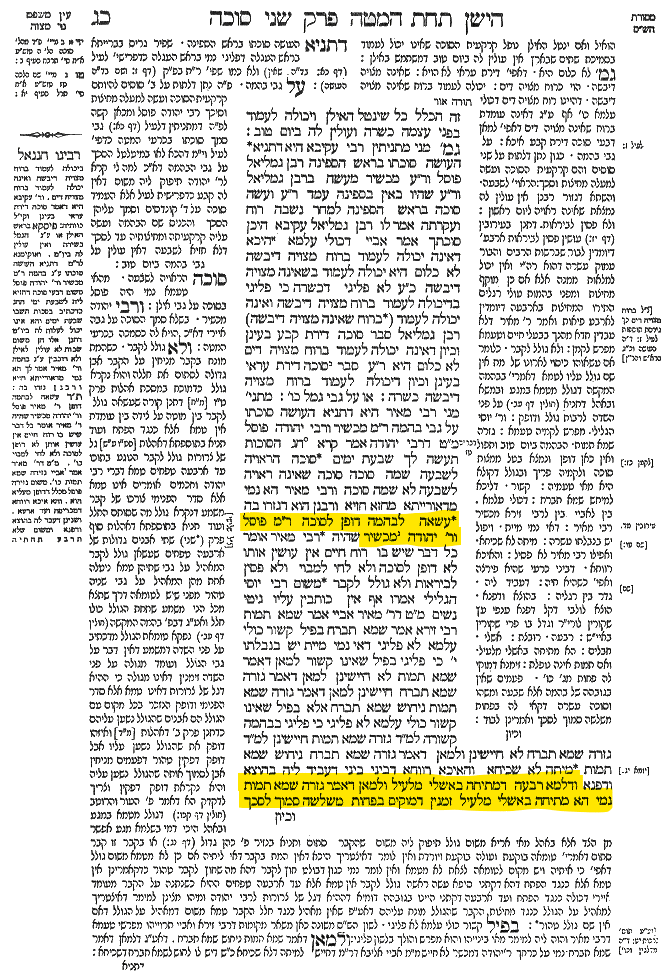
Also, another proof is where Gemara 23a cites a Baraisa that states: עשאה לבהמה דופן לסוכה — רבי מאיר פוסל ורבי יהודה מכשיר. Regarding this Baraisa, Abaye understands that R’ Meir invalidates the use of an animal as a sukkah wall out of concern that it might die, whereas Rebbi Yehuda validates it. The Gemara explains their dispute as where the animal is of average size and its top is within 3 tefachim from the s’chach, which qualifies the sukkah as having the required minimum 10 tefachim in height for a valid sukkah. From here we see that the Gemara understands that Rebbi Yehuda permits a sukkah to be built at 20 amos or lower in height.
(End.)
.
.
Rebbi Yehuda allows a sukkah to be higher than 20 amos because he holds that a sukkah is a דירת קבע, but what is his קבע requirement without which a sukkah would be invalid if he at the same time holds that a sukkah can also be built at 20 amos or lower in height?
The Gemara on 7b states: אמר אביי רבי ור’ יאשיה ורבי יהודה ורבי שמעון ורבן גמליאל ובית שמאי ורבי אליעזר ואחרים כולהו סבירא להו סוכה דירת קבע בעינן. Each one of the Tannaim listed holds that a sukkah needs a particular aspect of קבע in order for a sukkah to be valid. However, if Rebbi Yehuda simply allows a sukkah to be either above 20 amos in height, where it would be a דירת קבע, or 20 amos or lower where it would be דירת עראי, he would not belong on this list of Tannaim that maintain that a sukkah must be a דירת קבע בעינן.
Therefore, in accordance with the Meiri commenting on Gemara 2a, Rebbi Yehuda maintains that the קבע requirement of a sukkah can be satisfied either on the basis of the dimension of height or on the basis of the dimension of length and width.
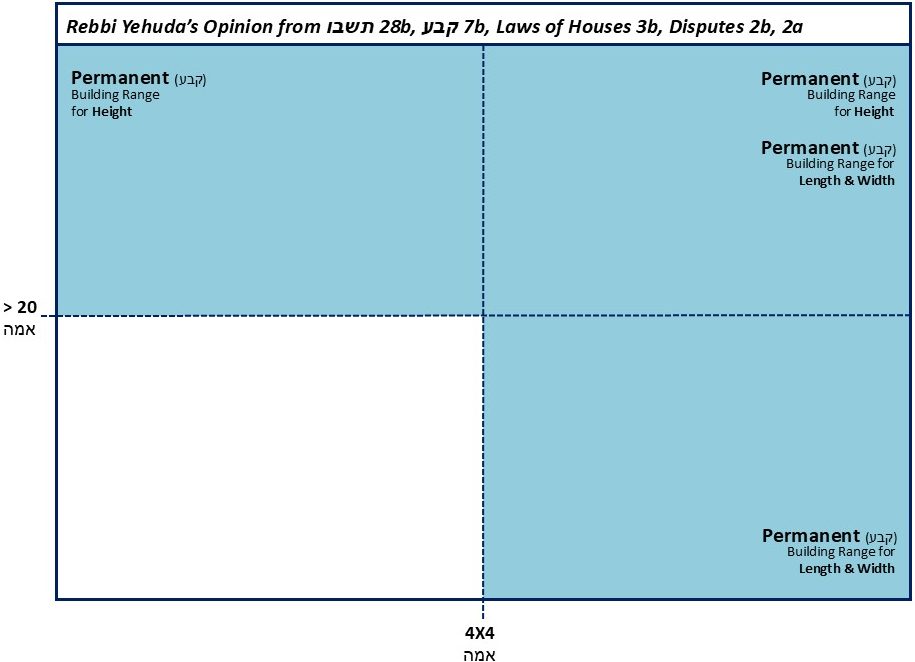
And this approach would be consistent with the Baraisa on 3b that a dwelling is considered to be a דירת קבע if it is 4×4 amos or greater in length and width. Likewise, this is similar to Rebbe’s opinion on 7b which defines the קבע of a sukkah solely in the terms of length and width at 4×4 amos or greater. Therefore, the difference between the two Tannaim is that Rebbi Yehuda utilizes height or length and width in defining a דירת קבע.
In an attempt to answer this same question, some may assert an alternative understanding of Rebbi Yehuda’s opinion by stating that perhaps Rebbi Yehuda could accept the קבע requirements of the other Tannaim. However, this approach would not be consistent with how the Ritva and Ran understand the Gemara’s use of the term כולהו סבירא להו, which they understand to mean that each disputant disagrees with his fellow in some aspect of the halacha.
This conclusion is further supported by the fact that Rebbi Yehuda can be seen to dispute R’ Shimon’s קבע requirement for a fourth wall in that he agrees with Mishna 2a that states: ושאין לה שלשה דפנות … פסולה. Therefore, a sukkah that has three walls is valid.
Likewise, Rebbi Yehuda can be shown to oppose Rabban Gamliel’s understanding of the קבע requirement of a sukkah in that it cannot be a mobile sukkah such as one that sits atop a wagon. This is observed in Gemara 23a which states that Rebbi Yehuda’s reason for invalidating a sukkah built on the back of an animal is based on the verse that states: חג הסוכות תעשה לך שבעת ימים, The festival of Succos you shall make for seven days. Rebbi Yehuda does not invalidate the sukkah because it is a mobile sukkah, rather because a sukkah atop an animal is rabbinically forbidden to be used in such as manner on Yom Tov and consequently cannot be utilized for all seven days. Therefore, it is only for the fact that this sukkah cannot be used on the one day of Yom Tov that Rebbi Yehuda invalidates the sukkah. The implication is that the Gemara understands that had it not been for the one day of Yom Tov Rebbi Yehuda would permit a sukkah to be built on top of the back of an animal. Therefore, Rebbi Yehuda would permit a sukkah to be built on top of a wagon since its use would not be forbidden on Yom Tov.
Furthermore, while Rebbi Yehuda allows a sukkah to be built at 4×4 amos or greater in length to qualify as a דירת קבע, in accordance with the understanding of the Ritvah and Ran, Rebbi Yehuda disputes Rebbe’s absolute minimum requirement of 4×4 amos when he validates a sukkah of less than that measurement. This is clearly seen on 2b where in the name of Rav, Rav Huna and Rav Chanan bar Rabbah state that the argument between the Tanna Kamma and Rebbi Yehuda is in a sukkah above 20 amos in height which is less than 4×4 amos in length and width.
(End.)
.
.
Why does Rav Huna in the name of Rav state that the dispute between the Tanna Kamma and Rebbi Yehuda in a sukkah above 20 amos is at exactly 4×4 amos rather than 4×4 amos and less?
The reason for this is that a shade ratio of 1:5 (length to height) is a diagonal line reaching 20 amos in height at exactly 4×4 amos. This means that if the dispute between the Tanna Kamma and Rebbi Yehuda was stated as being at 4×4 amos and less the reader would have thought that if the sukkah was merely 20 amos in height or lower it would be valid according to the opinions of the Tanna Kamma and Rebbi Yehuda. But this is not the case for either of their opinions.
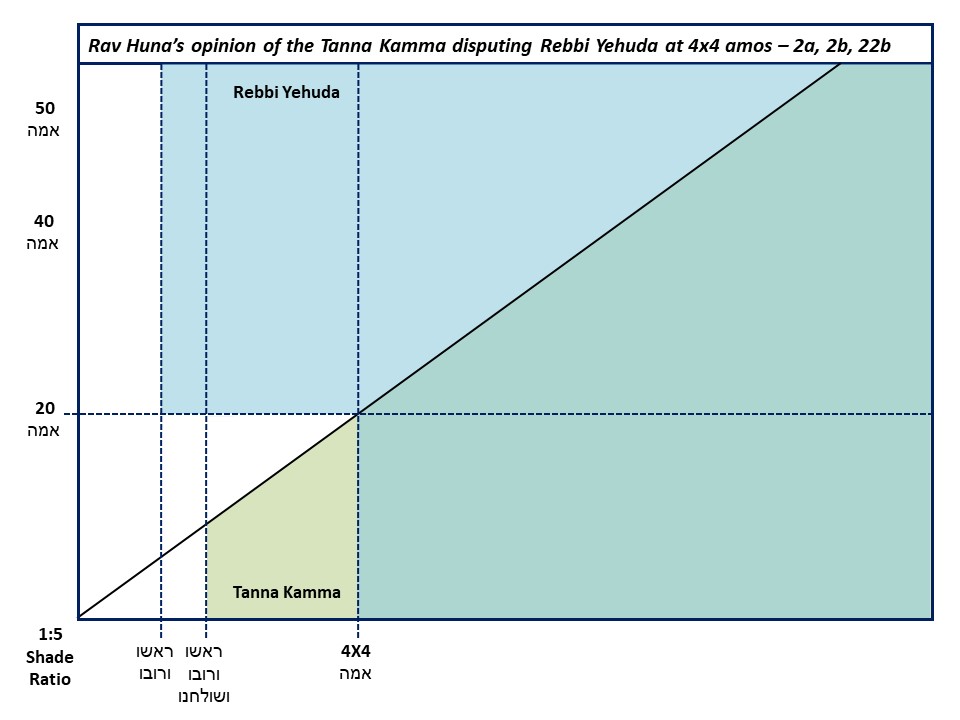
In regard to the Tanna Kamma’s opinion, examples can be found of how a sukkah such as one that is 2×2 amos can be no higher than 10 amos in height and one of 3×3 amos can be no higher than 15 amos in height. And regarding Rebbi Yehuda’s opinion of the קבע of a sukkah, Rebbi Yehuda invalidates a temporary sukkah which is built less than 4×4 amos in length and which is at the same time 20 amos or lower in height. Therefore, the dispute must be described as being at exactly 4×4 amos. However, both the Tanna Kamma and Rebbi Yehuda permit a sukkah which is built less than 4×4 amos.
(End.)
.
.
In the name of Rav, Rav Huna and Rav Chanan bar Rabbah argue over a matter of length on 2b, but what is the source of their dispute?
The Gemara on 22b states that when Mishna 2a says ושחמתה מרובה מצלתה פסולה it means that equal or greater shade of the s’chach must be present at the ground level where a person dwells, otherwise the sukkah is invalid. This is the opinion of all regarding the סיפא of Mishna 2a and not a unique requirement of Rebbi Zeira on 2a or Rav Huna on 2b.
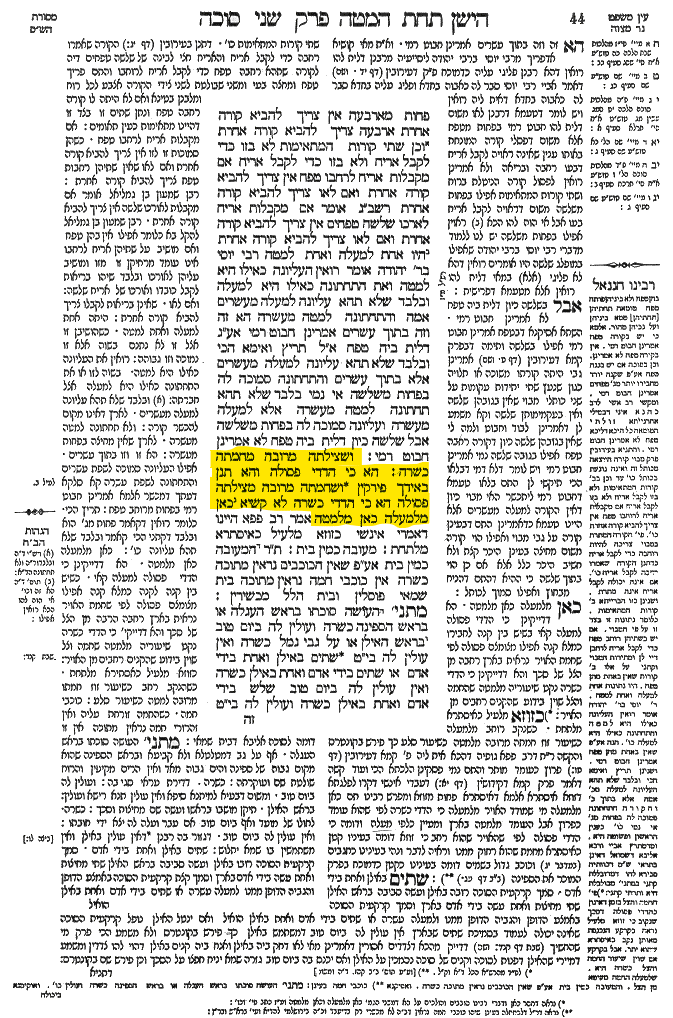
Therefore, we can deduce that an additional factor involved in the disputes between Rebbi Yehuda and the Tanna Kamma according to Rav Huna and Rav Chanan bar Rabbah, is not that the s’chach must be capable of producing shade at the floor of the sukkah where a person dwells (regarding this everyone agrees), but more specifically regarding the amount of time that the s’chach (and not the walls) must provide protection from the daytime heat in order for the sukkah to be valid, as the Torah states: וסוכה תהיה לצל יומם מחורב.
Imagine a person in a very hot desert. He needs protection from the daytime heat. Would a structure with a length to height ratio that provides only 5 minutes of shade at חצות be called a sukkah? Perhaps a legal sukkah must provide one or more hours of shade at the floor of the sukkah where a person dwells to be valid.
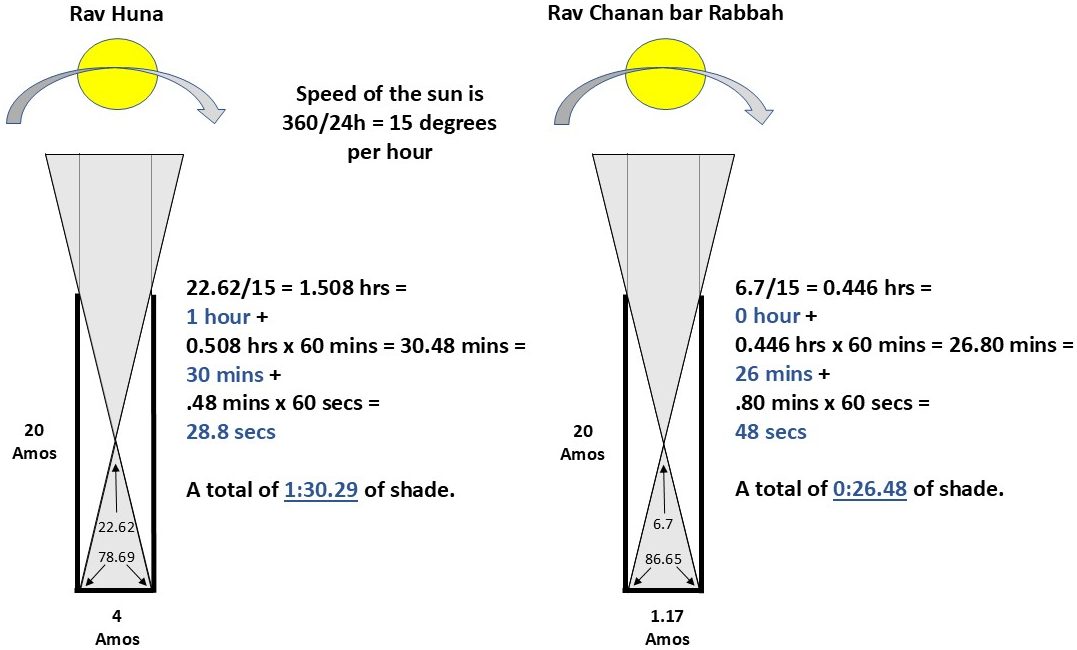
The Gemara on 2b explains that the Tanna Kamma of Rav Huna in the name of Rav understands that the source of the 20 amos height limitation of a sukkah is derived directly from the requirement that a sukkah must provide a certain amount of protective shade during the daytime heat, which according to him is minimally accomplished with a length to height ratio of 1:5, as the Gemara states: כמאן כרבי זירא דאמר משום צל הוא וכיון דרויחא איכא צל סוכה.
However, Rav Chanan bar Rabbah’s opinion also holds that a valid sukkah must provide equal or more shade at the ground level where a person dwells as described in Gemara 22b and Mishna 2a, but he does not hold that the 20 amos height limitation of a sukkah is derived from the requirement of shade, as does Rav Huna. Rather, the 20 amos height limitation of a sukkah is derived from the law of noticeability (למען ידעו), like Rabbah stated on 2a.
Consequently, this opinion of the Tanna Kamma did not have an answer for what the minimum amount of time is that a sukkah had to provide shade from the daytime heat. Therefore, the Tanna Kamma of Rav Chanan bar Rabbah’s opinion utilized the principle of תפשת מרובה לא תפשת תפשת מועט תפשת and determined the shade ratio from their understanding of the minimum size sukkah. And since this opinion of the Tanna Kamma holds that a sukkah is valid until 20 amos in height on the basis of למען ידעו and Beis Shammai’s opinion that a sukkah is a דירת קבע, which requires a minimum size sukkah of ראשו ורובו ושולחנו in regards to its length, it used these factors to define its opinion of what the minimum amount of time is that a legal sukkah must provide shade during the daytime heat.
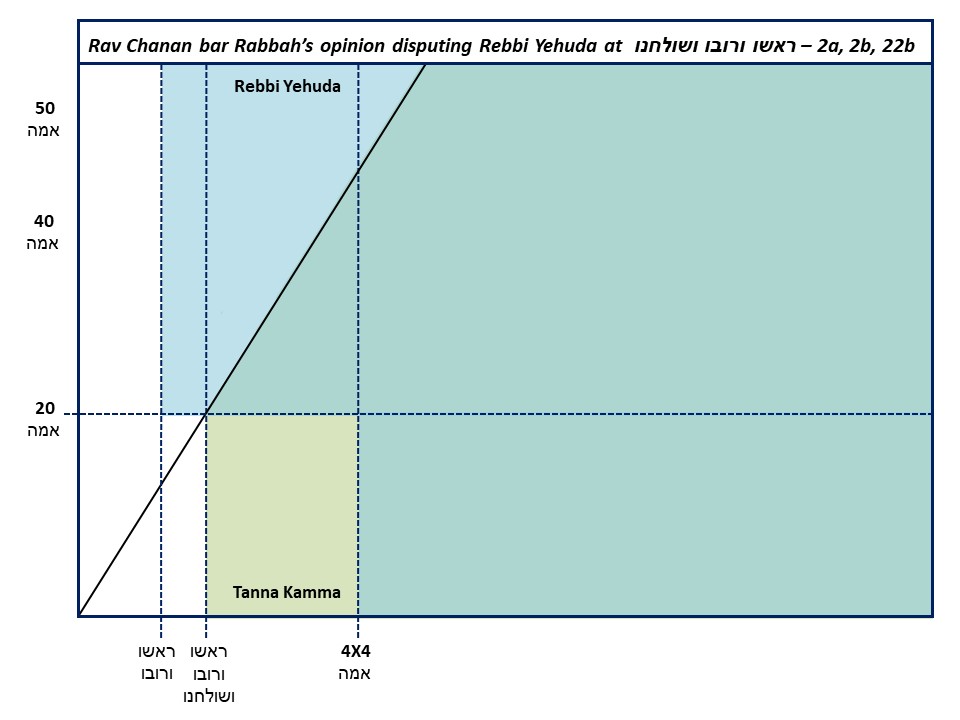
Therefore, Rav Huna maintained that a valid sukkah required 1 hour and 31 minutes of shade from the s’chach at the floor of the sukkah, while Rav Chanan bar Rabbah maintained that the minimum amount of shade from the s’chach is 27 minutes.
.

(End.)
.
.
Why does the Gemara state on 2b that Rav Chanan bar Rabbah’s opinion in the name of Rav is not like one of the three Amoraim?
Rav Chanan bar Rabbah’s opinion is not like the three Amoraim (Rabbah, Rebbi Zeira, and Rava) who attempt to explain the 20 amos height limitation of a sukkah. His use of תפשת מרובה לא תפשת תפשת מועט תפשת is coming to establish the Tanna Kamma’s opinion regarding the minimum amount of time that a sukkah must provide equal or more shade from the s’chach at the floor of the sukkah where a person dwells. And, through deduction it can be determined that Rav Chanan bar Rabbah’s opinion regarding the 20 amos height limitation of a sukkah is in accord with Rabbah, למען ידעו. In fact, from the perspective of Rav Chanan bar Rabbah’s opinion, Rebbi Yoshiyah’s dictum regarding the 20 amos height limitation of a sukkah and his dictum regarding the minimum amount of time that a sukkah must provide equal or more shade from the s’chach, represents a single opinion of the Tanna Kamma. Therefore, Rav Chanan bar Rabbah’s dictum is entirely dependent on Rebbi Yoshiyah’s dictum being correct.
And the simplest reason why למען ידעו is the only logical option as Rav Chanan bar Rabbah’s source for the 20 amos height limitation, is that he disputes Rav Huna at 4×4 amos, who is in accord with Rebbi Zeira, and Rava’s opinion of temporariness in regard to the dimension of height does not permit a sukkah to be over 20 amos. However, a more nuanced and complicated answer at this stage is that since Rav Chanan bar Rabbah’s opinion is based on Beis Shammai’s understanding that a sukkah is a דירת קבע requiring ראשו ורובו ושולחנו, he cannot at the same time hold that a sukkah is a דירת עראי like Rava who will be found later to be in accord with Beis Hillel.
The proof that this is the correct understanding of the Gemara is that after Rebbi Yehuda’s Baraisa regarding Queen Helene sukkah refutes Rebbi Yoshiyah’s dictum regarding the requirement that the walls must reach the s’chach, Rav Chanan bar Rabbah’s opinion is no longer addressed by the Gemara afterward. This is because the Gemara understands that Rav Chanan bar Rabbah’s opinion is dependent on Rebbi Yoshiyah’s source of למען ידעו being correct.
(End.)
.
.
If Rav Chanan bar Rabbah agrees with R’ Yoshiyah that the source for the 20 amos height limitation of sukkah is למען ידעו, why does the Gemara on 2b state that R’ Yoshiyah argues with Rav Chanan bar Rabbah because he gives a measurement of length?
This is because there is more than one factor that effects the height of a sukkah, as the Gemara on 2a previously stated: מיהו סוכה דנפישינ מיליה. While Rav Chanan bar Rabbah and R’ Yoshiyah agree that the source for the 20 amos height limitation of sukkah is למען ידעו, R’ Yoshiyah still argues with Rav Chanan bar Rabbah over the nature of the קבע needed for a valid sukkah, the definition of which also impacts the height of a sukkah. Rav Chanan bar Rabbah’s measurement of length represents his opinion that the קבע of a sukkah is in accordance with Beis Shammai, ראשו ורובו ושולחנו. This becomes the basis upon which he determines the minimum amount of time that the s’chach of the roof must be capable of producing shade at the floor of the sukkah, as the Gemara on 22b explains regarding the סיפא of Mishna 2a that states: ושחמתה מרובה מצלתה פסולה. Therefore, Rav Chanan bar Rabbah establishes a minimum shade ratio using the principle of תפשת מרובה לא תפשת תפשת מועט תפשת based on the 20 amos height limitation of למען ידעו and Beis Shammai’s opinion that a sukkah is a דירת קבע, which requires a minimum size sukkah of ראשו ורובו ושולחנו in length to accommodate a person’s table, 7b.
Whereas R’ Yoshiyah maintains that the קבע of a sukkah is that in addition to the roof, the sukkah’s walls must also provide shade when the sun is at diagonal to the sukkah. Because of this he understands that there is no minimum amount of time that the s’chach must provide shade at the floor of the sukkah, as the Baraisa on 7b states: ושחמתה מרובה מצלתה פסולה תנו רבנן חמתה מחמת סיכוך, ולא מחמת דפנות. רבי יאשיה אומר: אף מחמת דפנות. Therefore, R’ Yoshiyah argues with Rav Chanan bar Rabbah (and Rav Huna) in maintaining that a sukkah must provide shade for the entire day and not just for a certain amount of time during the daytime heat of the afternoon. Consequently, he holds that there is no universal height-limiting shade ratio and so long as the walls reach the s’chach the sukkah can extend far above 20 amos unimpeded.
 (End.)
.
.
Other than R’ Yoshiyah, how do any of the opinions accomplish equal or greater shade at the floor of the sukkah in accordance with Gemara 22b and Mishna 2a in a sukkah above 20 amos in height?
Given that the mitzvah of dwelling in a sukkah applies around the world, in both the Northern and Southern hemispheres at the same time during Yom Tov of Sukkot, the Tanna Kamma understood that the physical dimensions of a sukkah were determined on the basis of the sun passing over the sukkah at a perpendicular angle of 90-degrees. This would account for locations where a person is dwelling in exile, and the sunlight and heat of the day is the most direct and intense. The fact that this shade ratio and its resulting physical dimensions will produce less to even no shade time of the s’chach at the floor level in other locations of the world (such as Israel, Russia, or Australia) is not a concern.
Therefore, just as we are not concerned about the angle of the sun and the lack of shade of the s’chach produced at sunrise or at nighttime, so too the Torah is not concerned that this sukkah with its physical dimensions may be placed in locations of the world that do not experience the sun at a direct 90-degree angle and produce the same amount of shade from the s’chach.
(End.)
.
.
What is Rebbi Yehuda’s opinion regarding the minimum amount of shade time when he allows a sukkah to be as high as 40 or 50 amos?
As previously stated, the Ritva and Ran cite a tradition of the Geonim that the phrase כולהו סבירא להו, as used in Gemara 7b, indicates that the Tannaim disagree as to the nature of the קבע of a sukkah. Therefore, Rebbi Yehuda disputes Beis Shammai’s opinion that the קבע of a sukkah requires a person to bring his physical table inside the sukkah, which drives a minimum size sukkah of ראשו ורובו ושולחנו. Consequently, since Rebbi Yehuda does not require a table, he holds that the minimum size sukkah is ראשו ורובו. And since Rebbi Yehuda’s opinion is that a sukkah is a דירת קבע on the basis of an abstract dimension without limit above 20 amos, he does not and cannot utilize the principle of תפשת מרובה לא תפשת תפשת מועט תפשת to determine the proper amount of shade time. Rather, he holds that a sukkah needs only to provide proper shade at חצות for a singular moment when the sun is at a 90-degree angle to the sukkah.
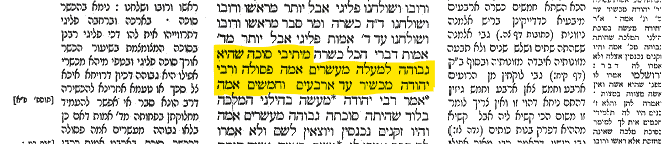
And Rebbi Yehuda informs us that this is the correct understanding of his opinion by stating in his Baraisa regarding Queen Helene’s sukkah in 2b, סוכה שהיא גבוהה למעלה מעשרים אמה פסולה ורבי יהודה מכשיר עד ארבעים וחמשים אמה. He states עד ארבעים וחמשים אמה to indicate that even at ראשו ורובו (one amah in length for the measurement of a person, 8a), a sukkah could be ארבעים or חמשים amos in height, which indicates that he does not hold by a ratio at all. Otherwise, he could not state either or.
Furthermore, he provided a רמז to his opinion that there is no shade ratio and that the minimum size sukkah is ראשו ורוב with the use of the numbers 40 and 50. Because the numerical value of 1 amah (ראשו ורוב), 40 amos, and 50 amos is 91, the gematria of סוכה.
(End.)
.
.
Why is there no transition from Rebbi Yehuda’s Baraisa of Queen Helene’s sukkah on 3a to Rav Shmuel bar Yitzchak stating the halacha of a minimum size sukkah?
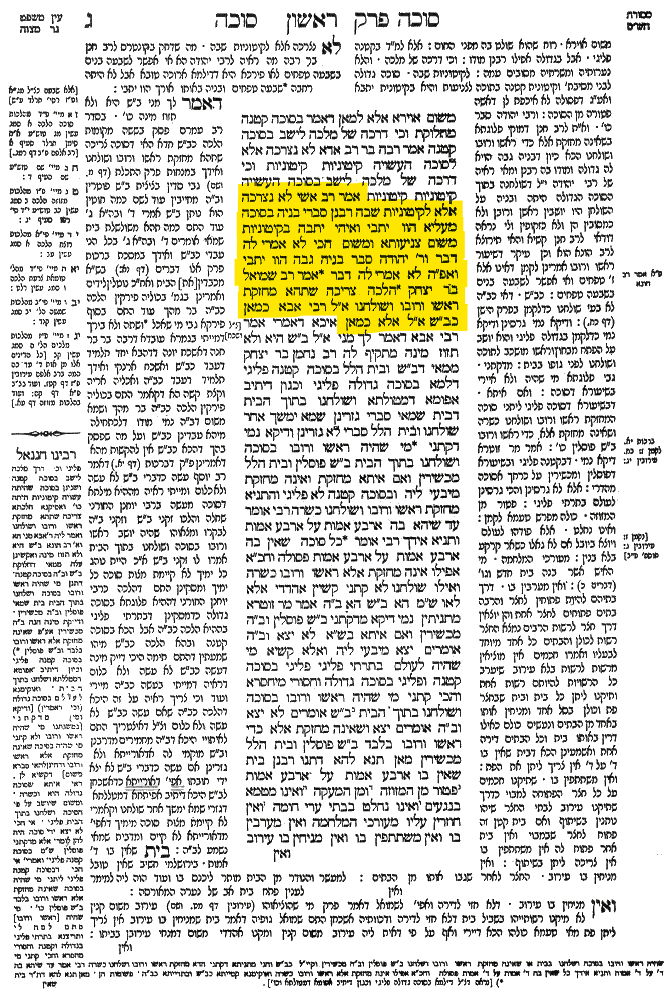
Rav Shmuel bar Yitzchak essentially said, Rebbi Yehuda’s Baraisa regarding Queen Helene’s sukkah has defeated Rebbi Yoshiyah and Rav Chanan bar Rabbah’s dictum in the name of Rav. Therefore, if you are going to maintain that the Rabbanan still dispute Rebbi Yehuda holding the opinion of Rav Huna, that the source for the 20 amos height limitation of a sukkah is that it requires a 1:5 shade ratio, then the consequence is that: הלכה צריכה שתהא מחזקת ראשו ורובו ושולחנו.
Rebbi Abba said to Rav Shmuel bar Yitzchak: כמאן כב”ש. According to whom are you ruling? According to Beis Shammai? But we poskin like Beis Hillel.
Rav Shmuel bar Yitzchak responded to Rebbi Abba, אלא כמאן, but according to whom could the halacha be, except Beis Shammai? For since, Rav Huna’s opinion maintains that the 20 amos height limitation of a sukkah is due to a 1:5 shade ratio, which allows a sukkah to be higher than 20 amos when beyond 4×4 amos, therefore the Rabbanan can no longer poskin that the minimum size sukkah is ראשו ורובו in accordance with Beis Hillel who holds that a sukkah is a דירת עראי, which requires this sukkah to be 20 amos or lower in height. This is because Beis Hillel’s understanding that a sukkah is a דירת עראי is concerned with the dimension of height as it relates to the s’chach of a sukkah, which consequently enables a sukkah as small as ראשו ורובו in length because he does not require the קבע of a table. Whereas Beis Shammai’s opinion that a sukkah is a דירת קבע on basis of a requirement that a table must be inside the sukkah, establishes the minimum length and width of a sukkah as ראשו ורובו ושולחנו.
Furthermore, since Rav Huna’s opinion maintains that a sukkah can be built at less than 4×4 amos, the Rabbanan can no longer poskin like Rebbe who maintains that a sukkah is a דירת קבע, which requires a minimum size sukkah of 4×4 amos. Consequently, the halacha for the minimum size sukkah must be decided in accordance with Beis Shammai that a sukkah is a דירת קבע which requires a person to bring his table into his sukkah in order to dwell in the manner that he normally does in his house all year long, 28b and 7b.
Finally, in regards to Rav Shmuel bar Yitzchak’s understanding of the dispute between Beis Shammai and Beis Hillel, which he understood in the terms of a דאורייתא requirement that a sukkah must be either a דירת עראי or דירת קבע, the Gemara adds that it was said by some that the exchange continued with R’ Abba asking, “who is it that told you” that Beis Shammai and Beis Hillel argue over a דאורייתא as to whether a sukkah is a דירת עראי or דירת קבע? And Rav Shmuel bar Yitzchak responded to Rebbi Abba, “it is Beis Shammai” that told me.
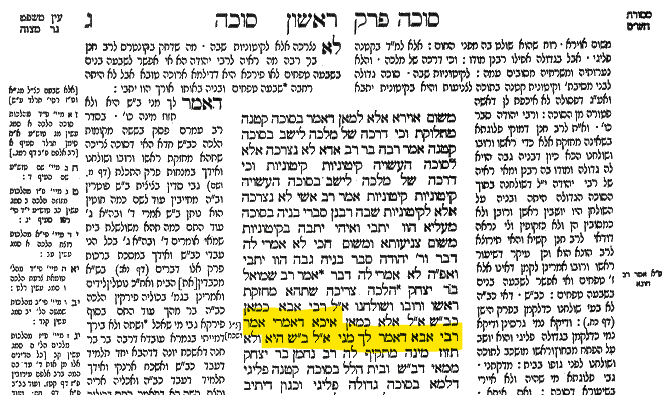
And the proof that Rav Shmuel bar Yitzchak’s statement is a continuation of the Gemara’s conversation regarding the dispute between the Tanna Kamma and Rebbi Yehuda in the Baraisa of Queen Helene’s sukkah, and not simply an introduction to a completely new topic where Rav Shmuel bar Yitzchak makes a halachic statement that was already universally accepted, is that Rav Nachman bar Yitzchak understands Rav Shmuel bar Yitzchak’s conversation with Rebbi Abba as concerning the case of Queen Helene’s sukkah hinging on the assumption that Beis Shammai and Beis Hillel are arguing in a small sukkah over a דאורייתא as to whether a sukkah is a דירת עראי or דירת קבע. Therefore, he asked on 3a: ממאי דב”ש ובית הלל בסוכה קטנה פליגי, from what evidence do you presume that Beis Shammai and Beis Hillel’s argument is over the halacha of a minimum size sukkah, which is derived from a דאורייתא? Perhaps their argument is over a דרבנן regarding the manner in which person eats.
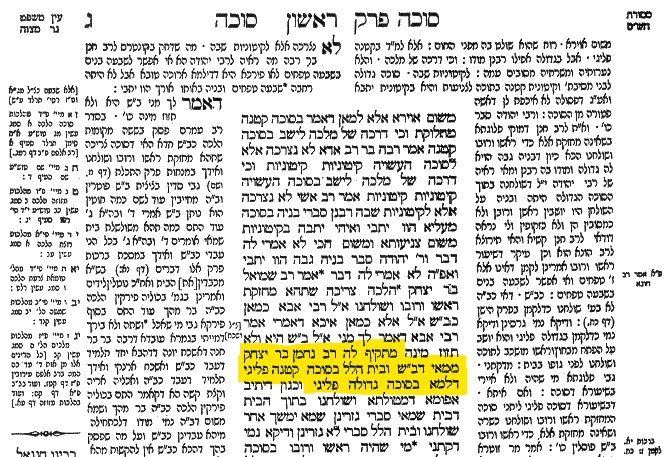
And, if Rav Shmuel bar Yitzchak’s statement was merely a halachic statement of fact Rav Nachman bar Yitzchak’s question would make no sense outside of the case of Queen Helene’s sukkah, because no other case has been presented in which the opinions of Beis Shammai and Beis Hillel are opposing each other. Therefore, Rav Shmuel bar Yitzchak and Rav Nachman bar Yitzchak are discussing the halachic difficulty that Rebbi Yehuda’s Baraisa creates for the Rabbanan.
(End.)
.
.
What is the meaning and significance of Rav Nachman bar Yitzchak’s challenge to Rav Shmuel bar Yitzchak?
מתקיף לה רב נחמן בר יצחק ממאי דב”ש ובית הלל בסוכה קטנה פליגי דלמא בסוכה גדולה פליגי וכגון דיתיב אפומא דמטולתא ושולחנו בתוך הבית דבית שמאי סברי גזרינן שמא ימשך אחר שולחנו ובית הלל סברי לא גזרינן
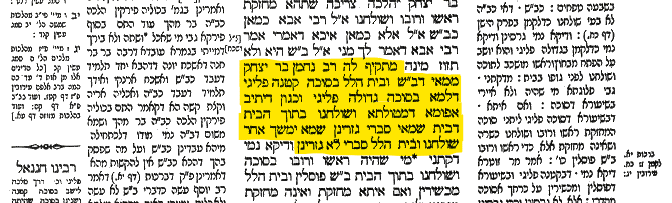
Rav Nachman bar Yitzchak is challenging Rav Shmuel bar Yitzchak’s understanding that the argument between Beis Shammai and Beis Hillel over the minimum size of a sukkah, is originating from a דאורייתא requirement. As such, a דאורייתא perspective of the argument represents a Torah requirement by Beis Shammai that a sukkah must be large enough to accommodate a person’s table and by Beis Hillel that a sukkah cannot be above 20 amos in height. And since Beis Hillel’s understanding of a דירת עראי is in the terms of the height of a sukkah, which does not involve a table, they can validate a minimum size sukkah regarding the dimension of length as small as ראשו ורובו. Therefore, they argue in a small sukkah over a דאורייתא as to whether a sukkah is a דירת עראי or a דירת קבע.
Rav Nachman bar Yitzchak’s assertion that their argument could possibly be over the manner in which one eats, which could even take place in a large sukkah, is an attempt to establish the argument as regarding a דרבנן. This would mean that the argument in the sukkah is not defined in terms of a דאורייתא requirement, that a sukkah must either be a דירת קבע or דירת עראי with their resulting minimum size sukkahs. In doing so, Rav Nachman bar Yitzchak is stating that the Rabbanan who argue with Rebbi Yehuda in Queen Helene’s sukkah, in accordance with Rav Huna’s opinion which permits a sukkah to be higher than 20 amos when larger than 4×4 amos on the basis of a 1:5 shade ratio, would not have to poskin in accordance with Beis Shammai that the minimum size sukkah is ראשו ורובו ושולחנו. Rather, if the argument between Beis Shammai and Beis Hillel is over a דרבנן regarding the manner in which a person eats from a table (whether in a large or small sukkah) that would mean that the Rabbanan can still poskin according to Beis Hillel in regards to a minimum size sukkah of ראשו ורובו because it wouldn’t matter anymore that Rav Huna permits a sukkah higher than 20 amos when beyond 4×4 amos in length.
(End.)
.
.
How do we know that the Gemara concluded that Beis Shammai and Beis Hillel are in fact arguing in a small sukkah over a דאורייתא requirement as to whether a sukkah is a דירת קבע or דירת עראי?
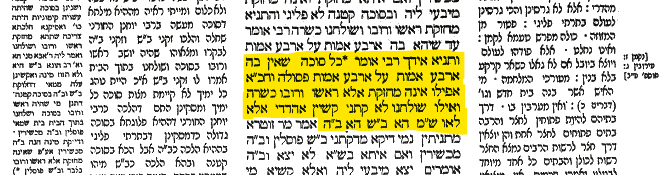
ותניא אידך רבי אומר כל סוכה שאין בה ארבע אמות על ארבע אמות פסולה וחכ”א אפילו אינה מחזקת אלא ראשו ורובו כשרה ואילו שולחנו לא קתני קשיין אהדדי אלא לאו ש”מ הא ב”ש הא ב”ה
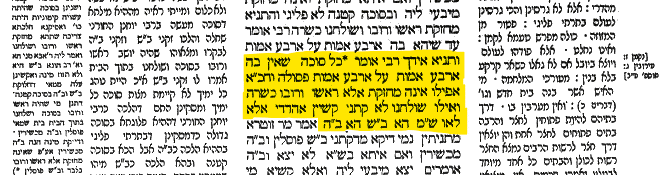
The proof that the Gemara rejected Rav Nachman bar Yitzchak’s challenge that Beis Shammai and Beis Hillel are arguing in a small sukkah over a דרבנן regarding the manner in which a person eats, is that after stating the Baraisa on 3a: רבי אומר כל סוכה שאין בה ארבע אמות על ארבע אמות פסולה וחכ”א אפילו אינה מחזקת אלא ראשו ורובו כשרה, the Gemara concludes with the statement: ואילו שולחנו לא קתני. Meaning, that since the Gemara finds Beis Hillel arguing over the minimum size sukkah of ראשו ורובו with Rebbe who holds that the minimum size sukkah is 4×4 amos, and it is clearly not over the manner in which one eats from a table, the Gemara deduces that Beis Hillel does in fact maintain that the minimum size sukkah originates from a דאורייתא requirement that a sukkah is a דירת עראי, just as shall be learned from the Baraisa on 3b regarding the laws of houses, that the Rabbanan can build a sukkah at less than Rebbe’s 4×4 amos because they also hold that a sukkah is a דירת עראי in accordance with Beis Hillel.
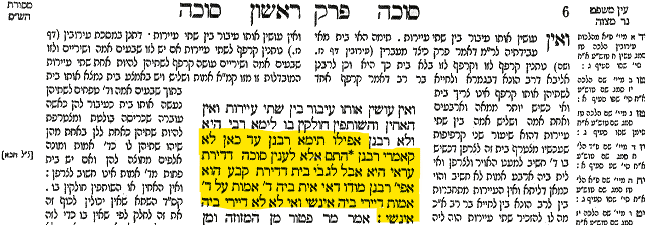
The Gemara then brings an additional proof with Mar Zutra who states that if the proper understanding of the argument was as Rav Nachman bar Yitzchak suggests, that Beis Shammai and Beis Hillel are arguing over a דרבנן regarding the manner in which a person eats, the Mishna should have concluded that Beis Shammai holds that a person does not discharge his obligation and Beis Hillel holds he does discharge, בש”א לא יצא וב”ה אומרים יצא.
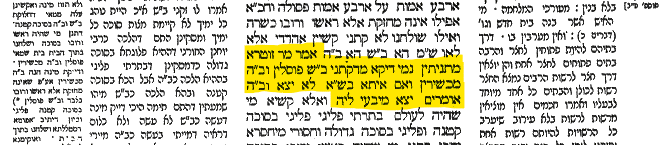
Instead, the Mishna states ב”ש פוסלין וב”ה מכשירין which indicates that Beis Shammai holds that the sukkah itself is invalid according to the Torah, while Beis Hillel maintains that it is valid. Therefore, since they do argue over the structural validity of a minimum size sukkah, they are arguing over a דאורייתא requirement. And, as such the Gemara rejects Rav Nachman bar Yitzchak’s challenge that the argument is over a דרבנן and cannot escape the halachic difficulty that Rav Shmuel bar Yitzchak has highlighted.
And this was the purpose of the Gemara stating on 2a, מאי שנא גבי סוכה דתני פסולה, ומאי שנא גבי מבוי דתני תקנתא סוכה דאורייתא תני פסולה. The principle of פסולה taught there only becomes relevant here on 3a for the reader to understand the language of פוסלין in our Mishna that states: מי שהיה ראשו ורובו בסוכה ושולחנו בתוך הבית, בית שמאי פוסלין ובית הלל מכשירין. This sequence of thought was purposefully orchestrated to indicate that the matter in dispute between Beis Shammai and Beis Hillel is regarding a דאורייתא, and not a דרבנן.
(End.)
.
.
What is the source of the dispute between Beis Shammai and Beis Hillel regarding the minimum size of a sukkah?
Mishna 28b states: כל שבעת הימים אדם עושה סוכתו קבע וביתו עראי. The Rabbanan further taught the Baraisa on 28b that states: ת”ר כל שבעת הימים אדם עושה סוכתו קבע וביתו עראי כיצד היו לו כלים נאים מעלן לסוכה מצעות נאות מעלן לסוכה אוכל ושותה ומטייל בסוכה. Therefore, it can be deduced that according to the Rabbanan on 3b and Beis Hillel on 3a to make one’s sukkah קבע and to transform his house into עראי, he needs only to אוכל ושותה מטייל בסוכה, because in the end a person may not have elegant dishes or fine linens. And this requirement corresponds to Beis Hillel’s minimum size sukkah of ראשו ורובו, that a person must be able to literally fit his head and most of his body inside the sukkah in order to be able to fulfill the requirement to אוכל ושותה ומטייל בסוכה.
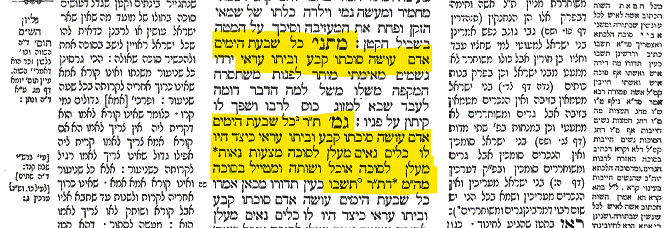
However, Beis Shammai’s opinion adds to the common denominator of ראשו ורובו, in concluding that a person must literally pull his table out of his house, making his house עראי, and place the table inside his sukkah (ראשו ורובו ושולחנו) in order for him to אוכל ושותה מטייל בסוכה as he normally dwells in his house all year long. And the proof that Beis Shammai requires the table to be removed from his house is that Mishna 3a states: מי שהיה ראשו ורובו בסוכה ושולחנו בתוך הבית ב”ש פוסלין ובית הלל מכשירין. Why does the Mishna state: ושולחנו בתוך הבית? Let the Mishna simply state that the table is outside the sukkah.

Regarding the requirement to make one’s sukkah קבע, what are the rationales of the Tannaim? In 28b, all hold that the Torah requires us to “תשבו” (dwell) in a permanent manner in a sukkah. Therefore, a sukkah must be a “dwelling” and not like other structures, such as a hut to merely sleep in or a watchtower from which to stand guard. Rebbe holds that a sukkah needs to be a permanent dwelling like a house, which if built less than 4×4 amos will lose its ability to be a dwelling, similar to the Baraisa on 3b which explains regarding houses: דאי אית ביה ד’ אמות על ד’ אמות דיירי ביה אינשי ואי לא לא דיירי ביה אינשי. Whereas Beis Shammai holds that the unique feature of a dwelling is that a person eats meals at a table, otherwise it is not a dwelling but more like a hut, watchtower or some other type of structure. However, Beis Hillel holds that if a person simply sat in the sukkah and ate their meals without a table it is enough to make it a valid dwelling, even without a physical aspect of קבע that would make it a דירת קבע structurally in a physical sense, as is found by the opinions of the Tannaim on 7b.
Therefore, the argument between Rebbe, Rebbi Yehuda, Beis Shammai and Beis Hillel is regarding the nature of קבע that constitutes a dwelling within which one can fulfill the commandment to “תשבו”. Beis Hillel uniquely makes his sukkah קבע through simply eating his meals in the sukkah as opposed to his house, while at the same time maintaining that the physical structure of a sukkah requires a דירת עראי based on the words שבעת ימים, like Rava transmits to us on 2a.
(End.)
.
.
Since the Gemara proves that Beis Shammai and Beis Hillel do argue in a small sukkah over a דאורייתא, and not like Rav Nachman bar Yitzchak suggested over a דרבנן, what then is the driving essence of Beis Shammai and Beis Hillel’s argument in a large sukkah at the conclusion of the Gemara’s discussion on 3a?
לעולם בתרתי פליגי פליגי בסוכה קטנה ופליגי בסוכה גדולה וחסורי מיחסרא והכי קתני מי שהיה ראשו ורובו בסוכה ושולחנו בתוך הבית ב”ש אומרים לא יצא וב”ה אומרים יצא ושאינה מחזקת אלא כדי ראשו ורובו בלבד ב”ש פוסלין ובית הלל מכשירין
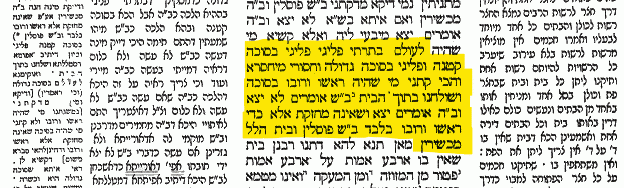
The main issue of dispute in both a small and large sukkah is concerning whether a literal table is required inside the sukkah to qualify as a valid dwelling. Consequently, regarding a small sukkah of ראשו ורובו the issue is not that the sukkah is approximately 6×6 tefachim, but that a sukkah of 6×6 tefachim necessarily does not permit Beis Shammai’s required table inside the sukkah from which a person must be able to eat. Therefore, a sukkah that is too small is structurally invalid on a דאורייתא level according to Beis Shammai, therefore ב”ש פוסלין. Whereas, regarding the dispute in a large sukkah the issue is not that the table cannot physically fit inside the sukkah. In this case, the sukkah itself is structurally valid according to the Torah, but since the table is not inside the sukkah from which one must eat their meals, the person does not discharge his דאורייתא obligation to dwell (תשבו) in a permanent manner, therefore ב”ש אומרים לא יצא to dwell in a sukkah.
Therefore, the Gemara is always referring to Beis Shammai’s requirement as an actual table which is required to be inside of the sukkah to be qualified as a dwelling when one eats his meals, which tangentially reveals a minimum size for a sukkah as ראשו ורובו ושולחנו on a דאורייתא level. The difference being not just semantics, but critical to the essence of the argument. For, if a person always dwelt in a small sukkah (ראשו ורובו) without a table, Beis Shammai would say to them as they did to R’ Yochanan ben HaChoranis on 28a: “In all your days you have never fulfilled the mitzvah of sukkah”. They did not state that he was dwelling in an invalid sukkah that was too small, but that they found him dwelling without a table.
מתני׳ מי שהיה ראשו ורובו בסוכה ושולחנו בתוך הבית — בית שמאי פוסלין ובית הלל מכשירין. אמרו להם בית הלל לבית שמאי: לא כך היה מעשה שהלכו זקני בית שמאי וזקני בית הלל לבקר את רבי יוחנן בן החורנית, ומצאוהו שהיה יושב ראשו ורובו בסוכה ושולחנו בתוך הבית, ולא אמרו לו דבר. אמרו להם בית שמאי: משם ראיה?! אף הם אמרו לו: אם כן היית נוהג, לא קיימת מצות סוכה מימיך.
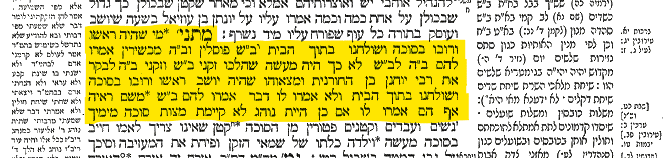
And this is the answer to the confusion recorded in Mishna 28a between the students of Beis Hillel and the students of Beis Shammai. The students of Beis Hillel viewed the dispute only in terms of the size of the sukkah and found a proof in the fact that the Elders of Beis Shammai did not say a word to R’ Yochanan ben HaChoranis about the small size of the sukkah which was ראשו ורובו. And Beis Shammai said, a proof from that! But, the elders of Beis Shammai said to him that if you have always eaten without your table inside the sukkah, you have never fulfilled the mitzvah of sukkah.
Restated in other words, since Beis Hillel holds that a sukkah is a דירת עראי, which limits the height of a sukkah in accordance with שבעת ימים to 20 amos, it allows a sukkah as small as ראשו ורובו in regard to length. Therefore, the students of Beis Hillel viewed the dispute between ראשו ורובו and ראשו ורובו ושולחנו in terms of a measurement of length. And therefore, they found a proof that a sukkah is a דירת עראי from the fact that Elders of Beis Shammai did not say anything to R’ Yochanan ben HaChoranis regarding the smallness of his sukkah. Beis Shammai then discounted their proof and supported their own opinion that a sukkah is a דירת קבע in pointing out that while the Elders of Beis Shammai did not speak about the small size of R’ Yochanan ben HaChoranis’ sukkah they strongly objected to his eating without a table. Therefore, the Elders did object to the small size of R’ Yochanan ben HaChoranis’ sukkah at the same time that they were rebuking him for not eating from his table.
(End.)
.
.
After discussing the dispute between Beis Shammai and Beis Hillel, why does the Gemara ask the reader on 3a to identify the author of the Baraisa on 3b regarding a house that is less than 4×4 amos?
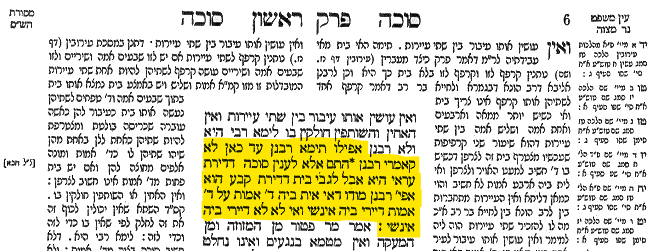
מאן תנא להא דתנו רבנן בית שאין בו ארבע אמות על ארבע אמות פטור מן המזוזה ומן המעקה ואינו מטמא בנגעים ואינו נחלט בבתי ערי חומה ואין חוזרין עליו מעורכי המלחמה ואין מערבין בו ואין משתתפין בו ואין מניחין בו עירובואין עושין אותו עיבור בין שתי עיירות ואין האחין והשותפין חולקין בו לימא רבי היא ולא רבנן אפילו תימא רבנן עד כאן לא קאמרי רבנן התם אלא לענין סוכה דדירת עראי היא אבל לגבי בית דדירת קבע הוא אפי’ רבנן מודו דאי אית ביה ד’ אמות על ד’ אמות דיירי ביה אינשי ואי לא לא דיירי ביה אינשי:
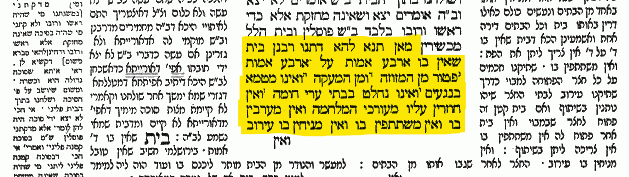
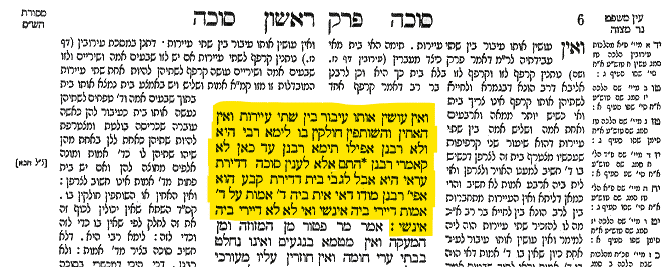
Since Beis Shammai and Beis Hillel were proven by the Gemara to be arguing in a small and large sukkah over a דאורייתא, Rav Shmuel bar Yitzchak’s logical argument remains standing that the halacha of a minimum size sukkah must be according to Beis Shammai, ראשו ורובו ושולחנו.
Therefore, as an alternative to Beis Shammai’s opinion the Gemara now suggests that perhaps Rebbe is the author of the Baraisa on 3b regarding a house that is less than 4×4 amos, and not the Rabbanan. In doing so, the Gemara is stating that if the Rabbanan are teaching Rebbe’s Baraisa about houses perhaps they should also follow his opinion regarding sukkahs. Consequently, the Gemara is suggesting to reject Rav Huna’s opinion of קבע, which is Beis Shammai’s requirement of ראשו ורובו ושולחנו and instead adopt Rebbi Zeira’s understanding of the dispute between the Tanna Kamma and Rebbi Yehuda on 2a and who holds according to Rebbe’s minimum size sukkah of 4×4 amos.
What is the practical difference and how do we know Rebbi Zeira held according to Rebbe’s opinion in regard to the קבע of a sukkah? Both Rebbi Zeira and Rav Huna hold that the 20 amos height limitation of a sukkah has its source in a 1:5 shade ratio, as the Gemara on 2b states that the two opinions are similar in that they both identify the source of the 20 amos height limitation of a sukkah as originating from this shade ratio. However, in regard to the קבע of a sukkah Rav Huna maintains that a sukkah can be less than 4×4 amos and even as small as ראשו ורובו ושולחנו, like Beis Shammai. Whereas Rebbi Zeira maintains that a person sits in the shade of a sukkah until 20 amos. How is this possible with a 1:5 shade ratio, since a person can see that a sukkah of 2×2 amos can only be as high as 10 amos and one of 3×3 amos can only be as high as 15 amos in height. In truth it is not possible. Rather, a person is able to sit in the shade of the sukkah until 20 amos because Rebbi Zeira holds in accordance with Rebbe’s understanding of קבע and maintains that a valid sukkah requires a minimum of 4×4 amos.

רבי זירא אמר מהכא: ״וסוכה תהיה לצל יומם מחורב״, עד עשרים אמה אדם יושב בצל סוכה, למעלה מעשרים אמה — אין אדם יושב בצל סוכה אלא בצל דפנות.
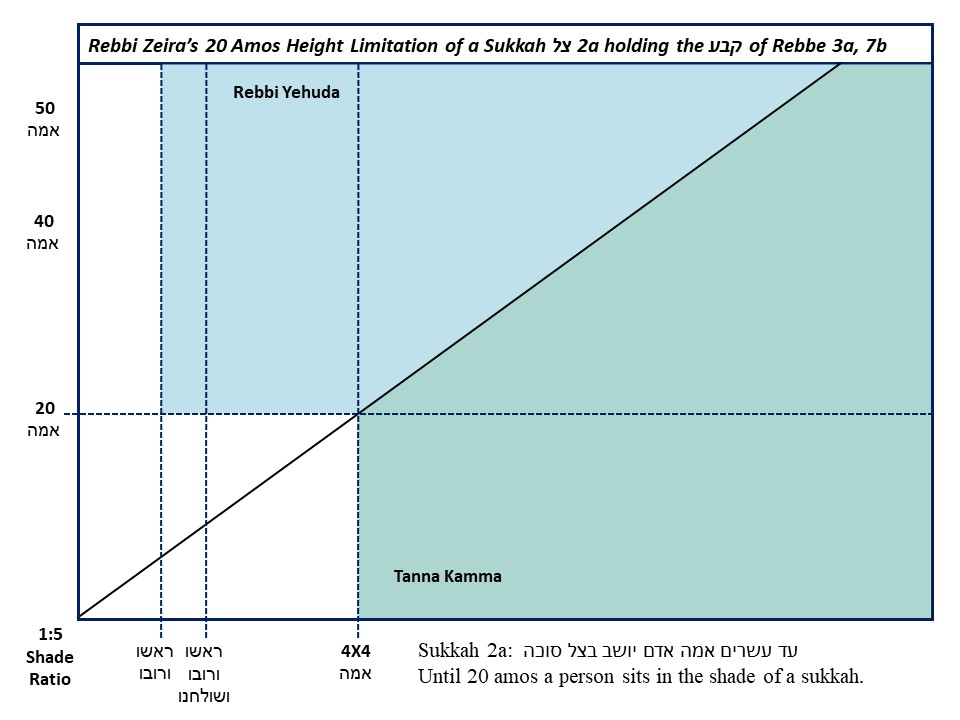
However, at this point the Gemara continues with adding another alternative to Beis Shammai by stating the opinion of the Rabbanan in context of Baraisa 3b: אפילו תימא רבנן עד כאן לא קאמרי רבנן התם אלא לענין סוכה דדירת עראי. In doing so the Gemara conspicuously leaves the question regarding the identity of the unknown author of the Baraisa on 3b unanswered and in front of the reader. This has also led the reader to understand that the Rabbanan actually hold that a sukkah is a דירת עראי in accordance with Beis Hillel and consequently that they hold that the minimum size sukkah is ראשו ורובו. This is understood from the Gemara previously stating that Beis Hillel validates a sukkah at less than Rebbe’s 4×4 amos on 3a, רבי אומר כל סוכה שאין בה ארבע אמות על ארבע אמות פסולה וחכ”א אפילו אינה מחזקת אלא ראשו ורובו כשרה ואילו שולחנו לא קתני קשיין אהדדי אלא לאו ש”מ הא ב”ש הא ב”ה.
(End.)
.
.
What are the logical consequences of the Gemara revealing on 3b that the Rabbanan maintain that a sukkah is a דירת עראי in accordance with Beis Hillel as described on 3a, when the Gemara interprets the Baraisa regarding a house that is less than 4×4 amos according to the Rabbanan’s perspective?
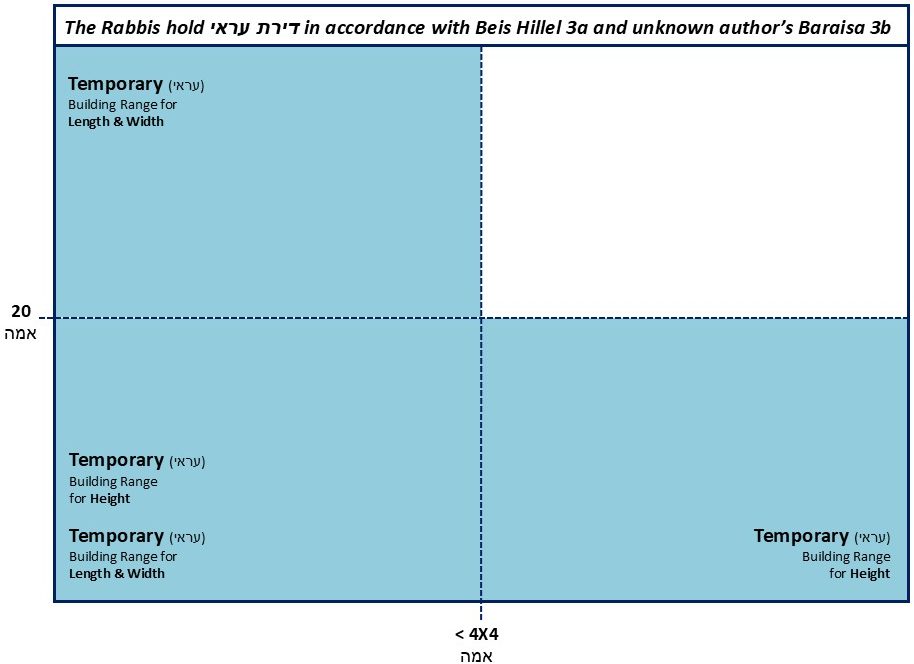
Until here the reader only understood a דירת עראי in terms of the height of a sukkah in accordance with a simplistic explanation of Rava on 2a. However, the Gemara explained on 3b that the reason it cannot ascribe with certainty the authorship of the Baraisa regarding a house that is less than 4×4 amos to Rebbe is because the Rabbanan could also have authored the Baraisa since they maintain that a sukkah built in an area which is less than 4×4 amos in regards to the dimensions of length and width is also considered a דירת עראי.
Therefore, just as Rebbi Yehuda holds that a sukkah is a דירת קבע which can be satisfied by being either higher than 20 amos in height or 4×4 amos or greater in length and width, the Rabbanan hold to the opposite that a sukkah is a דירת עראי which can be satisfied by being either 20 amos or lower in height or less than 4×4 amos in length and width, regardless of its height. Therefore, it can be concluded that Rebbi Yehuda and the Rabbanan both agree to the dimensions of קבע and עראי but only disagreed as to whether a sukkah is a דירת קבע or a דירת עראי from the words תשבו and שבעת ימים in the verse בסוכות תשבו שבעת ימים. And this further reinforces the explanation of the Gemara’s statement on 2a, מיהו סוכה דנפישינ מיליה, that the details for lowering the s’chach (סכך) of a sukkah are numerous therefore one cannot simply state ימעט.
And, the proof that Rabbanan hold that a sukkah is a דירת עראי on the basis of height or length and width, is that there is no way that they can maintain the concept of a דירת עראי according to a simplistic understanding of Rava’s opinion on Sukkah 2a and not be refuted by Rebbi Yehuda’s Baraisa regarding Queen Helene’s sukkah which was over 20 amos in height while the Elders were silent. Rather, it should be understood on 2a that Rava was only coming to explain the Mishna’s statement regarding the limitation of a sukkah in regard to the dimension of height specifically, but his explanation of a דירת עראי in regards to the dimension of length and width would be different and also in accord with Beis Hillel on 3a.
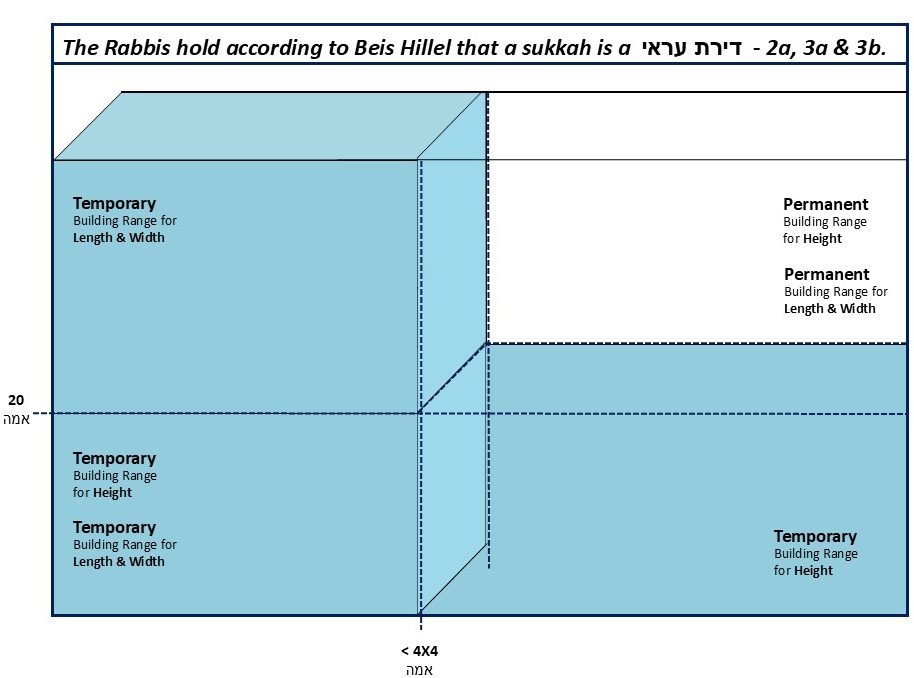
Therefore, it must be concluded that the opinion of Rav Huna in the name Rav, in which the Tanna Kamma disputes Rebbi Yehuda at exactly 4×4 amos, is the opinion of Beis Shammai, as the Gemara 3a states: איכא דאמרי אמר רבי אבא דאמר לך מני א”ל ב”ש היא ולא תזוז מינה. This is because beyond 4×4 amos and over 20 amos in height is a completely permanent dimension where the Rabbanan could not hold that a sukkah is a דירת עראי in either height or length and width in accordance with Beis Hillel. And, since Rav Huna’s opinion also allows a sukkah to be less than 20 amos in height and as small as ראשו ורובו ושולחנו, it is in a completely temporary dimension in regard to the dimensions of height and length and width, which Rebbe and Rebbi Yehuda dispute. Therefore, Rav Huna’s dictum in the name of Rav is transmitting Beis Shammai’s understanding of the 20 amos height limitation of a sukkah in accordance with צל and that the קבע of a sukkah requires one’s table.
Furthermore, the Gemara taught us to understand the proper questions to ask and how to extrapolate a more complete understanding of the Gemara. Given Rebbi Yehuda’s Baraisa regarding Queen Helene’s sukkah on 2b, and the understanding that the Rabbanan hold in accordance with the opinion of Beis Hillel, that a sukkah is a דירת עראי on the basis of either height or length and width (meaning that a sukkah can only be above 20 amos in height when it is built less than 4×4 amos in length), the reader should ask: “Is it the way of a queen to dwell in a small sukkah?” The Gemara has already taught us the answer: אמר רב אשי לא נצרכה אלא לקיטוניות שבה. Therefore, as opposed to Beis Shammai who disputes Rebbi Yehuda and maintains that her sons were sitting in the large sukkah which was over 20 amos high, the Rabbanan hold to the opposite according to Beis Hillel that a sukkah is a דירת עראי and maintain that Queen Helene was sitting in the small sukkah of less than 4×4 amos for privacy and her sons were sitting with her. Therefore, the Elders did not say a word to her about her sukkah being over 20 amos in height.
Furthermore, the opinion of Rav Huna in name the of Rav (which represents Beis Shammai’s opinion), the opinion of the Rabbanan (which represents the opinion of Beis Hillel), and the opinion of Rebbi Zeira (which represents the opinion of Rebbe), all argue with Rebbi Yehuda from different points of the dispute. And a רמז that the Gemara would come to prove that there were multiple opinions of dispute after having properly defined a דירת עראי and דירת קבע, is that the Gemara on 3a stated: רבנן סברי בניה בסוכה מעליא הוו יתבי. It should have stated בסוכה גדולה to reflect Rav Huna’s dictum in the name of Rav. However, since Beis Shammai, Beis Hillel, and Rebbe’s opinions all argued with Rebbi Yehuda the Gemara states בסוכה מעליא to accommodate all of the disputes.
Therefore, in conclusion since Queen Helene’s sukkah’s walls did not reach the s’chach and the Elders did not say a word to her, it disproves R’ Yoshiyah’s dictum in the name of Rav which is in accord with Rabbah who states למען ידעו is the source for the 20 amos height limitation of a sukkah. In addition, since Rav Chanan bar Rabbah’s dictum in the name of Rav is based on למען ידעו being correct, his calculation for a required shade ratio on the basis of the principle of תפשת מרובה לא תפשת תפשת מועט תפשת is also refuted.
However, according to Rebbi Zeira who maintains that a sukkah requires a 1:5 shade ratio and is a דירת קבע in accordance with Rebbi’s opinion, he would say that her sons were sitting in the large sukkah that was greater than 4×4 amos and over 20 amos in height. Therefore, the Elders did not say a word to her. While Rebbi Yehuda maintained that her sons sitting in her private sukkah which was exactly 4×4 amos while over 20 amos in height.
But regarding Rav Huna in name the of Rav, who maintains that a sukkah requires a 1:5 shade ratio and is a דירת קבע in accordance with Beis Shammai’s opinion, the Gemara states that the Rabbanan held that her sons were sitting in the large sukkah that was greater than 4×4 amos and over 20 amos in height. Therefore, the Elders did not say a word to her about her sukkah being over 20 amos. While Rebbi Yehuda maintained that her sons were sitting in the small sukkah which was 4×4 amos or less while above 20 amos in height.
Finally, according to the Rabbanan who maintain that a sukkah is a דירת עראי in accordance Beis Hillel, they held that Queen Helene was sitting inside a small sukkah of less than 4×4 amos which was higher than 20 amos in height and her sons were sitting with her. Therefore, the Elders did not say a word to her. And according to them, Rebbi Yehuda maintained that her sons were sitting in the large sukkah which was 4×4 amos or greater while above 20 amos in height.
(End.).
.
.
A Preemptive Reply.
.
.
Why not employ the solution offered by the תוספות רי”ד and ריטבא who conceptualize Queen Helene’s sukkah as being comprised of two sections with differing heights to explain how the Rabbanan maintained their opinion that a sukkah is a דירת עראי?
After explaining Rebbi Yehuda’s Baraisa of Queen Helene’s sukkah which was higher than 20 amos, the Gemara on 2b describes his disputes with R’ Yoshiyah, Rav Huna, and Rav Chanan bar Rabbah, but seemingly makes no effort to describe the dispute with Rava who holds that a sukkah is a דירת עראי.
This becomes even more intriguing because unlike the other three opinions the halacha seems to agree with Rava that a sukkah is a דירת עראי and yet the Gemara never directly describes his dispute with Rebbi Yehuda outside of the Mishna. Furthermore, this dispute should be of particular interest to the Gemara since its description and details would reveal the context in which the polar-opposite opinions of Rebbi Yehuda (a sukkah is a דירת קבע) and Rava (a sukkah is a דירת עראי) are pitted against each other. However, the Gemara did not do this. Why?
Some may reference the תוספות רי”ד and ריטבא, who address this glaring omission by suggesting that for Rava we can modify the understanding of Rebbi Yehuda’s Baraisa and say that Queen Helene’s sukkah had two rooms, one room was 20 amos or lower and the other room was higher than 20 amos. And even though the queen was sitting in the invalid room with the higher s’chach, the elders did not say a word to her because her sons were sitting in the valid room which was 20 amos or lower. And while this approach provides a logical framework within which a defense for Rava’s opinion can be sustained, the broader context and subsequent discussion brought by the Gemara indicates a reason for the omission and reveals a different understanding of the nature of the dispute between Rebbi Yehuda and Rava – between קבע and עראי. This is observed when the Gemara informs us through a series of deductions that Rava’s opinion that a sukkah is a דירת עראי is derived from Beis Hillel and that Beis Hillel’s understanding of a דירת עראי includes the dimension of length and width, not just the dimension height. The Gemara achieves this in several crucial steps.
First, it utilized Rebbi Yehuda’s stalemated dispute with Rav Huna’s 1:5 shade ratio in Queen Helene’s sukkah as context to define the functional difference between Beis Shammai’s opinion that a sukkah דירת קבע, requiring a table inside the sukkah, and Beis Hillel’s opinion that a sukkah is דירת עראי, which limits the height of a sukkah to 20 amos. The outcome of which impacts the minimum size of a sukkah. However, the Gemara’s deductive reasoning also effectively connects Rava and Beis Hillel’s opinions that a sukkah is a דירת עראי at the same time. This is because if Rav Huna’s sukkah, which is based on a 1:5 shade ratio that allows the sukkah to be higher than 20 amos when beyond 4×4 amos in length, is accepted as the reason for the 20 amos height limitation of a sukkah in Mishna 2a it would invalidate their common understanding of a דירת עראי. And as explained previously this is the meaning and significance behind Rav Shmuel bar Yitzchak’s extrapolation that: הלכה צריכה שתהא מחזקת ראשו ורובו ושולחנו.
Next, the Gemara continues with proving that Beis Shammai and Beis Hillel are not arguing in a large or small sukkah over a דרבנן regarding the manner in which a person eats, as Rav Nachman bar Yitzchak challenges. Rather their argument is found to be over a דאורייתא as to whether a sukkah is a דירת עראי or דירת קבע. In the process the Gemara further defines Beis Hillel’s concept of a דירת עראי as one that includes more than just the dimension of height. Beis Hillel’s concept of דירת עראי is understood to also include the dimension of length and width when he argues with Rebbe over the minimum length and width of a sukkah. This is clearly seen on 3a when the Gemara states:
ותניא אידך רבי אומר כל סוכה שאין בה ארבע אמות על ארבע אמות פסולה וחכ”א אפילו אינה מחזקת אלא ראשו ורובו כשרה ואילו שולחנו לא קתני קשיין אהדדי אלא לאו ש”מ הא ב”ש הא ב”ה
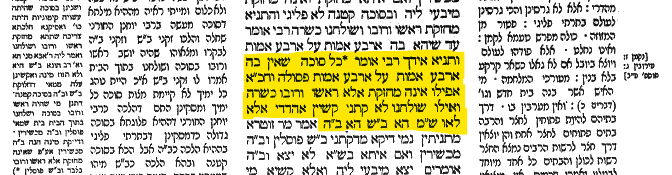
Finally, the Gemara ties the Rabbanan, Beis Hillel, and Rava all together using the Baraisa on 3b regarding the laws of houses when it states that the Rabbanan could also have authored the Baraisa because they can build a sukkah at less than Rebbe’s 4×4 amos because they hold that a sukkah is a דירת עראי in accordance with Beis Hillel on 3a and Rava on 2a. Therefore, Beis Hillel holds that a sukkah can also acquire the quality of עראי by being built at less than 4×4 amos in length and width as opposed to having to be built at 20 amos or less in height.
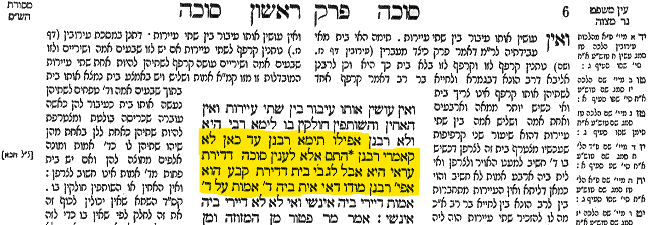
The proof that this is the correct understanding of the Gemara is that the Gemara on 3b states: עד כאן לא קאמרי רבנן התם אלא לענין סוכה — דדירת עראי היא. But prior to this point in the Gemara on 3b, where did the Rabbanan ever speak about a sukkah being a דירת עראי, except that it must be on 3a where Beis Hillel argues with Beis Shammai over a דאורייתא involving the dimension of height in the case of Queen Helene’s sukkah and where Beis Hillel argues with Rebbe over the dimension of length and width.
After the Gemara establishes that Rava’s opinion that a sukkah is a דירת עראי is derived from Beis Hillel and that Beis Hillel’s understanding of a דירת עראי includes the dimension of length and width, the reader can infer how Beis Hillel (and Rava) avoid refutation by Rebbi Yehuda’s Baraisa regarding Queen Helene’s sukkah that was over 20 amos high while the Elders were silent.
Therefore, based on the context of the Gemara which developed an understanding of Beis Hillel’s opinion, the Rabbanan who maintain that a sukkah is a דירת עראי held that Queen Helene was sitting inside a small sukkah of less than 4×4 amos which was higher than 20 amos in height and her sons were sitting with her. Therefore, the Elders did not say a word to her. And according to Rebbi Yehuda, he maintained that her sons were sitting in the larger invalid sukkah which was 4×4 amos or greater while over 20 amos in height. Thus, the complete context of the Gemara indicates that it conceptualized Rebbi Yehuda’s argument with the Rabbanan as in a sukkah that was entirely over 20 amos.
(End.)
.
.
If the Rabbanan who hold that a sukkah is a דירת עראי allow a sukkah to be above 20 amos why does the Gemara on 3b discuss the need to reduce its size with various materials implying that a sukkah above 20 amos is invalid?
Analyzing this Gemara in context of Beis Hillel’s opinion that was just explained in the previous section, when does such a case like this occur? This is a case in which the sukkah was built 4×4 amos or larger and over 20 amos in height, making it a דירת קבע. Therefore, the Rabbanan who maintain that a sukkah is a דירת עראי in accordance with Beis Hillel, state that if one came to reduce its height, as opposed to its length, it must be done with the right materials and intentions. The purpose of this Gemara is to address how to make a correction to the floor of a sukkah when such a case occurs.

(End.)
.
If the Rabbanan who hold that a sukkah is a דירת עראי permit a sukkah to be built above 20 amos, why does the Gemara state on 4a that a sukkah whose s’chach provides shade from above 20 amos is invalid?
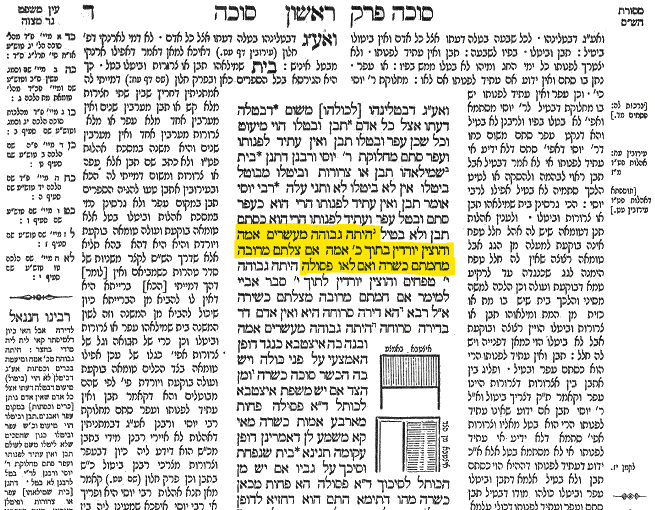
This is also a case in which the sukkah is 4×4 amos or larger. Therefore, if the portion of the s’chach that produces enough shade is above 20 amos in height, the sukkah cannot be considered a valid דירת עראי. Therefore, the purpose of this Gemara is to address how to make a correction to the ceiling of a sukkah when such a case occurs.
(End.)
.
.
If so, what is the dispute between the Tanna Kamma and Rebbi Yehuda according to the Babylonian Sages regarding a sukkah atop another sukkah in Mishna 9b?
Mishna 9b states: סוכה על גבי סוכה העליונה כשרה והתחתונה פסולה ר’ יהודה אומר אם אין דיורין בעליונה התחתונה כשרה – A sukkah atop another sukkah, the upper one is valid and the lower one is invalid. Rebbi Yehuda says: If there are no tenants in the upper one, the lower one is valid.
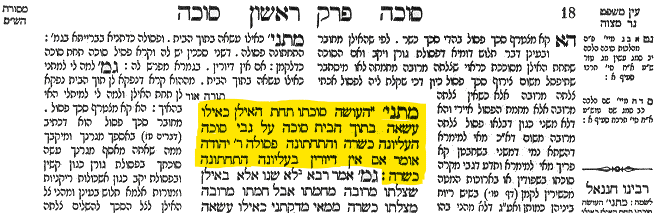
The Gemara then details on 10a the understanding of the Rabbis in the West according to Rav Dimi, which explains the dispute as one regarding a flimsy roof that can barely support tenants in the upper sukkah. And, on the basis of the materially weak roof they understood that Rebbi Yehuda’s opinion holds that the upper sukkah is פסול, while the lower is one valid. While the Tanna Kamma which holds that a sukkah is a דירת עראי, maintains that the upper sukkah which is made of flimsy materials is valid, making the lower one invalid. This is the opinion of the West and not the Babylonian Sages.
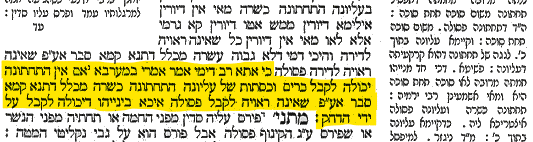
The Babylonian Sages understood Mishna 9b on the basis of the previously concluded opinion of the Gemara on 3b, that the dispute between the Rabbanan and Rebbi Yehuda is a case where the upper sukkah is smaller than 4×4 amos in length and 20 amos or lower in height. And since Rebbi Yehuda requires a sukkah to be a דירת קבע on the basis of its dimensions, if the upper sukkah is smaller than 4×4 amos and 20 amos or less in height it is not fit for tenancy and is פסול, while the Rabbanan who holds that a sukkah is a דירת עראי on the basis of its dimensions, maintain that the upper sukkah is valid and the lower one is פסול. As such, the Rabbanan and Rebbi Yehuda, according to the Babylonian Sages, hold that a sukkah is defined as a דירת עראי or a דירת קבע on the basis of abstract dimensions, as Rava clearly restates his opinion to clarify this to Abaye who challenged him in asking אלא מעתה עשה מחיצות של ברזל.
To which Rava replied:
הכי קאמינא לך עד כ’ אמה דאדם עושה דירתו דירת עראי כי עביד ליה דירת קבע נמי נפיק למעלה מכ’ אמה דאדם עושה דירתו דירת קבע כי עביד ליה דירת עראי נמי לא נפיק
In conclusion, to adopt Rav Dimi’s opinion from the West is to reject Rava’s understanding of a דירת עראי on 2a and the Gemara’s explanation of Beis Hillel’s opinion on 3a and 3b that a דירת עראי and דירת קבע is defined by its dimensions as opposed to the strength of the materials used to construct a sukkah. And, if one mistakenly interprets the Gemara to mean that a דירת עראי is defined by its material construct rather than its abstract dimensions, then they will be defeated by Rebbi Yehuda’s Baraisa of Queen Helene’s sukkah, which was over 20 amos in height while the Elders were silent. Consequently, they will have no basis for their understanding as to how the Tanna Kamma of Masechet Sukkah, Mishna 2a maintained that a sukkah is a דירת עראי.
(פשט)
.
.
Rabbi Akiva’s Sukkah, 20260221b
.
.
 Rabbi Akiva's Sukkah